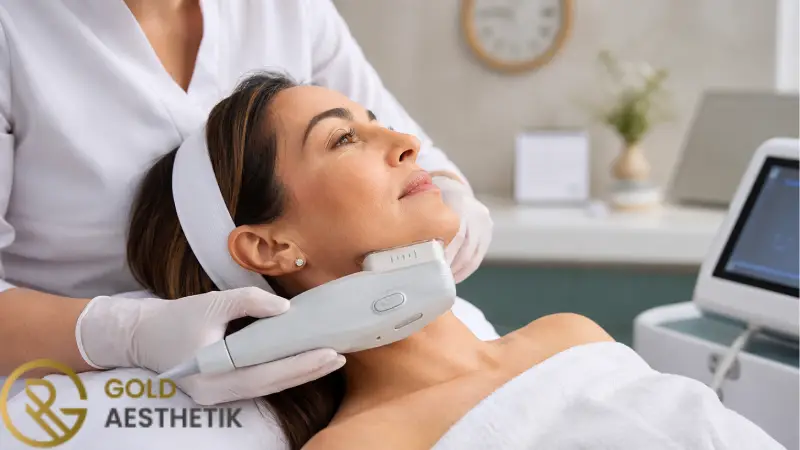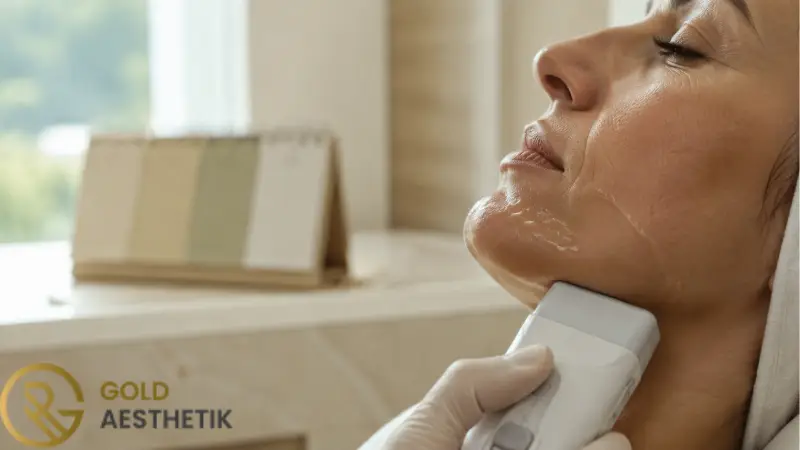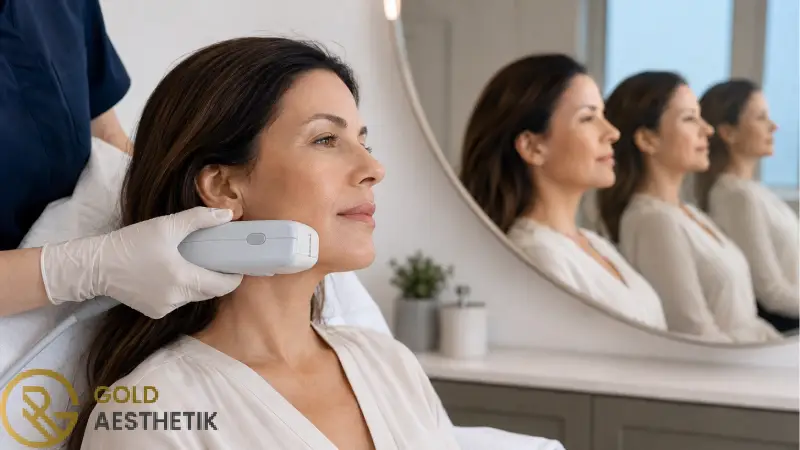
HIFU results usually appear gradually, and you should not expect to see the final skin change immediately after the treatment ends. Some people feel slight tightness or a mild “pulling” sensation in the first few days, but this early change is different from the main HIFU result. The real result develops when collagen production and remodeling processes are activated in the deeper layers of the skin.
When do HIFU results become visible?
For most people, the first visible changes appear within 4 to 8 weeks. The result becomes clearer in the second and third months, and in some individuals the improvement continues up to the sixth month. The exact timing depends on age, skin quality, degree of laxity, treatment area, the body’s response, and device settings.
Are HIFU results visible immediately?
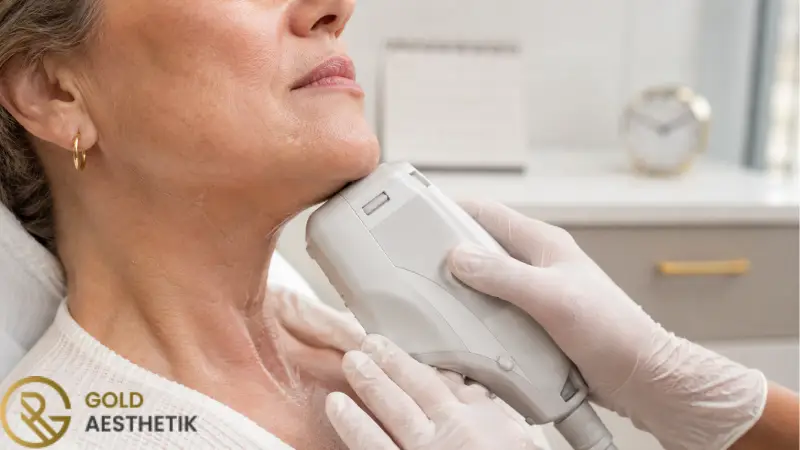
Immediately after HIFU, the skin may look slightly tighter or the jawline may appear a little more defined. This is not seen in everyone, and its absence does not mean the treatment has failed. Part of this early effect can be due to the tissue’s rapid response to ultrasound energy and a limited contraction of existing collagen fibers.
The main effect of HIFU takes time, because the body needs to produce new collagen and the skin structure is rebuilt gradually. For this reason, judging the result on the same day or in the first week is not reasonable. The best approach is to assess the skin at set intervals using standardized photos.
| Time frame | Possible changes | A realistic patient expectation |
|---|---|---|
| Immediately after treatment | A mild feeling of tightness or limited firmness | The initial change may be mild or barely noticeable |
| Week 1 to 4 | Start of the skin’s remodeling response | The final result cannot yet be assessed |
| Week 4 to 8 | Improved skin firmness and contour definition | The first visible changes appear |
| Month 2 to 3 | Increased firmness and gradual improvement of lines | The result becomes more noticeable for many people |
| Month 3 to 6 | Continued collagen remodeling | The result may continue to develop gradually |
What is the difference between the initial effect and the true HIFU result?
The initial effect of HIFU is usually limited and may present as a feeling of tightness, a slight reduction in laxity, or a temporary improvement in facial contour. The true result refers to changes created by gradual collagen remodeling, which develop over several weeks to a few months.
This difference is important, because sometimes a person sees a quick change and assumes the final result is guaranteed. Conversely, some people think the treatment was ineffective because they do not notice a clear change in the first days. Neither of these impressions is sufficient to evaluate the outcome.
| Type of result | Cause | When it appears | How noticeable it is |
|---|---|---|---|
| Initial effect | Rapid tissue response and limited collagen contraction | Same day to the first weeks | Usually mild |
| Developing result | Start of collagen production and remodeling | Around 4 to 8 weeks | Gradual and noticeable |
| Main result | Completion of a significant part of the remodeling process | Around 2 to 3 months | Clearer and more stable |
| Late result | Ongoing natural skin response | Up to around 6 months in some people | Depends on skin condition |
HIFU results in the first, third, and sixth month
In the first month, the skin may look slightly firmer, but it is still too early for a final assessment. At this stage, the body is beginning the repair process and collagen production. Even if no significant change is seen, the treatment outcome cannot be judged as negative.
The third month is usually a more suitable time to assess the skin’s response. Changes in skin firmness, jawline contour, or laxity in the treated area may be clearer at this time. In the sixth month, the late result can also be evaluated, especially if a person’s collagen response is slower.
The speed at which results appear is not the same in all areas. Skin thickness, degree of laxity, and the treatment goal can shift the timing of visible changes.
To learn more about this topic, we recommend reading the article HIFU for the double chin and jawline.
| Treatment area | Likely onset of changes | Time to assess the final result |
|---|---|---|
| Face and cheeks | Around 4 to 8 weeks | Around 2 to 3 months |
| Jawline | Around 4 to 8 weeks | Around 3 months |
| Double chin | A few weeks to a few months | Around 3 to 6 months |
| Neck | Around 6 to 12 weeks | Around 3 to 6 months |
| Brow area | A few weeks after treatment | Around 2 to 3 months |
When can the final HIFU result be assessed?
For many people, the third month is a suitable time for the main assessment. However, in some patients the skin remodeling process continues up to the sixth month. Therefore, the assessment timing should be determined based on the initial skin condition, the treatment area, and the individual response.
For an accurate comparison, it is best to take facial photos before treatment and in the following months with the same lighting, angle, camera distance, and facial expression. Changes in lighting or angle can make the result appear better or worse than it truly is. At Gold Aesthetik Hamburg, an individualized skin assessment before treatment helps set more realistic expectations about when results are likely to appear. No time frame is definitive for everyone, and the result should be evaluated by the physician at the follow-up appointment.
How long do HIFU results last, and when do they start to fade?
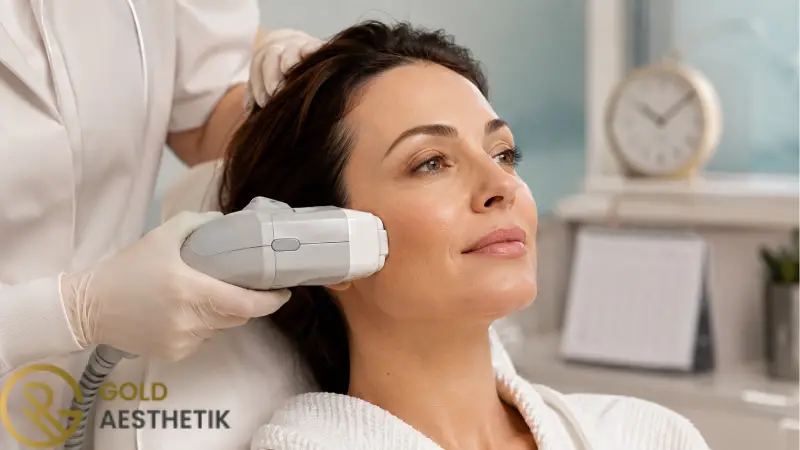
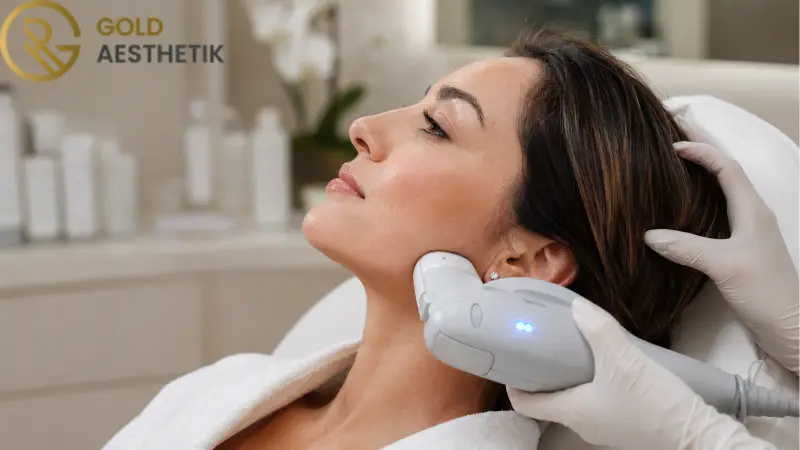
The longevity of 3D HIFU is not the same for everyone, but the results of this treatment typically last around 9 to 18 months. In some people, the effect may fade sooner, while in those with better skin quality, lifestyle factors, and collagen response, the result may remain visible for longer.
Age, degree of skin laxity, treatment area, weight changes, sun exposure, smoking, device quality, and how the treatment is performed all affect how long the result lasts. For this reason, it is not possible to state a definitive duration for HIFU longevity before assessing the skin.
If you are looking for more comprehensive information, the article Aftercare following microneedling can be a helpful guide.
How long do facial HIFU results last?
Facial HIFU results typically last between 9 and 18 months, but this range is a general estimate and is not a guarantee for all patients. After receiving ultrasound energy, the body begins the collagen remodeling process. This process can lead to a relative increase in skin firmness and improvement in mild to moderate laxity.
HIFU does not stop the natural aging process. Even after achieving the desired result, collagen loss and natural skin changes continue. Therefore, the effect does not disappear suddenly; it usually fades gradually over time.
People with mild to moderate laxity, relatively stable weight, and favorable skin conditions may experience a clearer and longer-lasting result. In contrast, severe laxity, rapid weight loss, or poor skin quality can limit both the response and the durability of the outcome.
| Treatment area | Likely longevity | Influencing factors |
|---|---|---|
| Face and cheeks | Around 9 to 18 months | Age, skin quality, and degree of laxity |
| Jawline | Around 9 to 18 months | Facial shape, skin laxity, and weight changes |
| Double chin | Around 6 to 18 months | Tissue volume, weight, and the type of concern |
| Neck | Around 6 to 15 months | Skin thinness, age, and degree of laxity |
| Brow area | Around 6 to 12 months | Skin quality and collagen response |
These figures are only approximate ranges. The device type, depth and energy settings, number of shots, and the practitioner’s skill can also affect the outcome. An in-person assessment determines which areas HIFU is suitable for and what you should realistically expect.
HIFU longevity for the double chin, neck, and jawline
The treatment goal for the double chin, neck, and jawline is not always the same. For the jawline, the focus is usually on reducing skin laxity and making the jawline border more defined. In the neck area, skin quality and thickness become more important. A double chin may be due to skin laxity, fat accumulation, or a combination of both.
If the prominence of the double chin is mainly due to excess fat or facial structure, HIFU alone may not achieve the expected result. Likewise, in necks with severe sagging, the outcome of non-surgical treatment will be more limited. Correct patient selection and identifying the main cause of the concern are more important than promising a fixed duration.
The reduction of HIFU effects is usually gradual. Over time, a person may notice reduced skin firmness or less definition of the jawline. These changes do not necessarily mean the skin has fully returned to its baseline, and they should be compared with standardized pre-treatment photos.
For more details and practical tips, read the article Microneedling or PRP.
| Sign | Possible cause | Appropriate action |
|---|---|---|
| Gradual decrease in skin firmness | Ongoing natural aging process | Reassessment by the physician |
| Less jawline definition | Skin laxity or weight change | Identify the cause before repeating treatment |
| Return of a double-chin appearance | Weight gain, fat, or sagging | Determine the type of concern and choose the treatment |
| Increase in fine lines | Dryness, sun exposure, or collagen loss | Adjust skincare and have an examination |
| Different results on each side of the face | Natural structural differences or tissue response | Compare photos and seek medical evaluation |
Are HIFU results permanent?

No, HIFU results are not permanent. HIFU can stimulate collagen production, but it cannot stop aging, natural collagen loss, or the impact of environmental factors. Phrases such as “permanent lift” or “guaranteed multi-year longevity” should not be the basis for decision-making.
How long the effect lasts depends on the body’s response. Regular sunscreen use, avoiding smoking, maintaining relatively stable weight, getting enough sleep, and skin-appropriate care can help support overall skin quality. However, no aftercare makes HIFU results permanent.
The best time to repeat HIFU
Repeating HIFU should not be done simply because a fixed date has been reached. The right time is when the previous result has fully developed, the current skin condition has been assessed, and the physician confirms a real need to repeat the treatment. Doing additional sessions too early or without indication does not necessarily improve the result.
For many people, reviewing the result in the third month and then reassessing again around 9 to 12 months later is reasonable. If the effect is still satisfactory, an immediate repeat session may not be necessary.
For a more informed decision, we recommend first reading the article Microneedling for acne scars.
| Skin condition | When to reassess | Physician’s suggested decision |
|---|---|---|
| Good and stable result | Around 9 to 12 months later | Continue care and postpone repeating |
| Gradual decrease in skin firmness | Around 9 to 15 months later | Consider a maintenance session |
| Limited response to the first session | After completing the 3- to 6-month period | Review the cause and consider an alternative treatment |
| Severe laxity | Before any new session | Evaluate more suitable methods |
| Significant weight change | After weight has stabilized | Reassess the face and neck |
At Gold Aesthetik Hamburg, the timing of repeat treatment is determined based on examination, skin response, and the patient’s goal. This individualized approach helps ensure treatment is performed only when needed and that patients have realistic expectations about the extent and duration of results.
Which factors change HIFU results and longevity?

HIFU results do not depend only on having a single session. Skin characteristics, age, severity of laxity, the body’s natural ability to produce collagen, the treatment area, the device type, and how the treatment is performed all affect the quality and longevity of the outcome. For this reason, two people treated at the same clinic may not experience the same result.
A careful review of these factors before treatment helps set more realistic expectations. For some patients, HIFU can lead to a noticeable improvement in skin firmness, but for others a different treatment may be a more suitable choice.
The impact of age and degree of skin laxity
Age alone does not determine whether someone is a suitable candidate for HIFU. The actual skin condition, degree of laxity, tissue thickness, and collagen-producing capacity are more important. However, increasing age is usually associated with a slower rate of collagen production and can affect when results appear and how long they last.
People with mild to moderate laxity are usually better candidates for HIFU. If the skin still has good regenerative capacity, collagen stimulation can increase firmness and improve facial contour to some extent. With severe laxity, HIFU may not produce a dramatic change comparable to a surgical lift.
HIFU results at older ages are not necessarily weak. Rather than deciding based only on age, the physician should assess the skin condition and facial structure.
If you have more questions about this topic, you will find the answers in the article Mesotherapy for hair loss.
| Potential impact | Controllability | |
|---|---|---|
| Age | Changes the speed of collagen production and skin remodeling | Not controllable |
| Degree of laxity | Determines the intensity of the expected result | Limited |
| Baseline skin quality | Affects how noticeable and durable the result is | Can be improved to some extent |
| History of aesthetic treatments | May affect the treatment plan | Manageable by providing accurate information |
| General health status |
Which factors change HIFU results and longevity?
HIFU results do not depend only on having a single session. Baseline skin condition, age, degree of laxity, the body’s collagen-producing capacity, the device type, and the physician’s skill can change when results appear and how long they last. For this reason, two people of a similar age may experience different outcomes after HIFU.
Understanding these factors helps you set more realistic expectations. HIFU is designed to improve mild to moderate laxity, and its result develops gradually. If patient selection or treatment settings are not appropriate, even a well-known device will not produce a satisfactory outcome.
The impact of age and degree of skin laxity
Age alone does not determine whether HIFU will be effective. The actual skin condition matters more than the number. Some people at an older age still have relatively resilient skin and a good capacity to produce collagen, while a younger person’s skin may have reduced quality due to sun exposure, smoking, or significant weight loss.
HIFU usually produces a more noticeable result for people with mild to moderate laxity. If laxity is very severe, the change achieved by a non-surgical treatment may not match the person’s expectations. In such cases, other methods or combination treatment should be considered.
We have examined this topic in more detail in the article Facial mesotherapy.
| Individual factor | Potential impact | Controllability |
|---|---|---|
| Age | Gradual decrease in the rate of collagen production | Not controllable, but assessable |
| Degree of laxity | Determines the intensity of the expected result | Manageable by choosing the appropriate treatment |
| Skin quality | Affects how noticeable and durable the result is | Can be improved to some extent with proper care |
| Health status | Affects the body’s natural response | Requires medical assessment |
| History of aesthetic treatments | May change the treatment plan and timing | Manageable by providing accurate information |
| Patient expectations | Affects satisfaction with the result | Can be adjusted through realistic consultation |
The impact of skin quality and collagen-producing capacity
The main mechanism of HIFU is based on stimulating the repair and collagen remodeling process. Therefore, skin that responds better may show a clearer and longer-lasting result. Skin thickness, sun damage, severe dryness, a history of smoking, and the natural aging process all influence this response.
Collagen-producing capacity cannot be determined solely by the skin’s appearance. The physician should assess thickness, firmness, degree of laxity, and the structure of the treatment area. Results are also not the same across all parts of the face. For example, the jawline response may differ from the neck or double chin.
You should not expect supplements, creams, or heavily marketed diets to definitively increase HIFU longevity. Proper care can support overall skin health, but it does not replace correct treatment selection and appropriate medical execution.
The role of the device, energy settings, and the physician’s skill
The device name alone does not guarantee a result. The physician must choose the appropriate depth, energy level, number of shots, and treatment pattern based on facial structure and skin quality. Using the same settings for everyone can lead to weak results or increase the risk of side effects.
The physician’s skill in understanding facial anatomy is particularly important. Energy must be delivered to the target layer while protecting sensitive areas. It is also necessary to determine before treatment whether the main issue is skin laxity, volume loss, fat accumulation, or a combination, because HIFU does not address all of these concerns equally.
To complete your information, you may also refer to the article Under-eye mesotherapy.
| Treatment factor | Its role in the result | Key point |
|---|---|---|
| Device quality | Accurate and consistent energy delivery | Brand name alone is not enough |
| Cartridge depth | Delivers energy to the target layer | Must match the treatment area |
| Energy level | Affects controlled tissue stimulation | More energy is not always better |
| Number and distribution of shots | Adequate coverage of the area | Must be determined based on facial structure |
| Physician’s skill | Patient selection and safe execution | Anatomical knowledge is essential |
| Treatment plan | Sets follow-up and repeat timing | Must be tailored to each individual |
The impact of smoking, sun exposure, weight changes, and lifestyle
Smoking can affect skin quality and the body’s natural healing process. Sun exposure is also one of the main causes of collagen damage and increased signs of skin aging. Regular use of a sunscreen suitable for your skin is important for maintaining overall skin health.
Rapid weight loss or gain can also change facial shape and the degree of skin laxity. If a person loses a significant amount of weight after HIFU, reduced facial volume may make the treatment result less apparent. It is best to perform treatment when weight is relatively stable.
Adequate sleep, balanced nutrition, physical activity, and sufficient water intake support overall health, but they should not be presented as a guaranteed way to increase HIFU longevity.
How can you make HIFU results last longer?
To maintain results, you should first follow your physician’s specific post-treatment instructions. Protecting the skin from the sun, quitting smoking, maintaining stable weight, and using skincare products appropriate for your skin type can help manage skin aging more effectively.
Before choosing the right method, we recommend reading the guide How many PRP sessions are needed for hair and face?
| Care measure | When to do it | Expected effect |
|---|---|---|
| Use sunscreen | Daily, and reapply as needed | Reduces sun-related damage |
| Avoid smoking | Consistently | Supports skin health and quality |
| Maintain stable weight | In the months after treatment | Reduces sudden changes in facial shape |
| Gentle skincare | As recommended by the physician | Prevents unnecessary irritation |
| Take standardized photos | Before treatment and at follow-up | More accurate result assessment |
| Attend a follow-up assessment | Usually after the result has fully developed | Determines whether repeating is truly needed |
A repeat session should not be done simply because a few months have passed. At Gold Aesthetik Hamburg, the skin condition and how much of the result remains are assessed before recommending another treatment. This individualized evaluation prevents unnecessary sessions and helps choose the right time to repeat HIFU.
Natural beauty, guided by precise medical decisions

At Gold Aesthetik, every aesthetic treatment begins with one key principle: choosing a method that truly matches your needs, facial structure, and skin condition. Dr. Mohammadreza Haghdadi, a specialist in vascular surgery and aesthetic medicine, together with his professional team in Hamburg, follows your treatment journey from the initial consultation to outcome assessment with care and an individualized approach.
At the Gold Aesthetik practice, you can benefit from a wide range of services such as 3D HIFU, Botox, fillers, mesotherapy, PRP, microneedling, lipolysis, thread lifting, eyelid lift, and hair transplantation. Our goal is to create harmonious, natural changes tailored to each individual—without unrealistic promises or unnecessary treatments.
If you are still unsure whether HIFU is suitable for your skin or which method may deliver a better result, an in-person consultation can provide clear answers to your questions.
Gold Aesthetik—where beauty is combined with medical expertise, precision, and respect for your natural features.
Practice address: Barmbeker Str. 40، 22303 Hamburg-Winterhude