



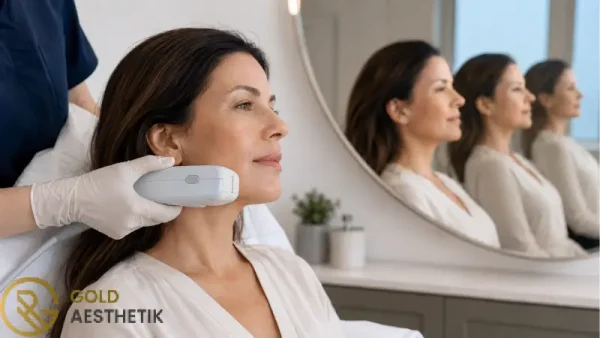
How long does HIFU last and when can the result be reliably assessed? A fixed timeframe does not apply to all patients. The result typically develops gradually because the treatment does not aim solely for an immediately visible effect, but rather to stimulate repair and collagen processes in the treated tissue.
Initial changes may become visible after several weeks, while the skin’s appearance can continue to evolve over the following months. How pronounced the tightening is and how long the result lasts depends on factors including skin quality, degree of skin laxity, treatment area, aging process, individual tissue characteristics, and the specific execution of the treatment.
When Are HIFU Results Visible?
The result of a HIFU treatment is normally not fully visible immediately after the appointment. Some patients notice a slight feeling of tightness or a subtle change in contour early on. However, this early impression should not be equated with the later treatment result.
The tissue response develops over an extended period. Therefore, an assessment a few days after treatment is usually too early. Changes often become more visible over the following weeks and can continue to develop over several months.
Are HIFU Results Immediately Visible?
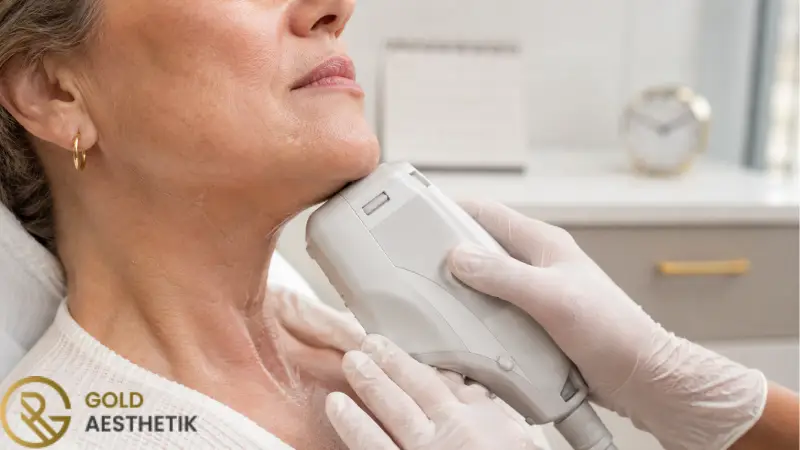
Directly after treatment, the treated tissue may feel somewhat firmer in some individuals. A slightly more defined jawline may also be temporarily noticeable. In other patients, there is hardly any visible change immediately after the appointment.
Both courses can occur. The absence of an immediate effect does not automatically mean the treatment was unsuccessful. For actual assessment, the tissue should be given sufficient time for its natural response.
| Time After HIFU | Possible Development | Classification |
|---|---|---|
| Directly after treatment | Slight feeling of tightness or subtle contour change possible | Not yet a reliable final result |
| Week 1 to 4 | Early tissue response and beginning remodeling processes | Usually too early for final assessment |
| Approximately week 4 to 8 | First more noticeable changes may become visible | Individual differences are normal |
| Month 2 to 3 | Tightening and contour can become more assessable | More suitable time for follow-up examination |
| Further months | Tissue response can continue to develop | Course depends on skin and treatment plan |
Why Does the HIFU Result Develop Gradually?
HIFU works with focused ultrasound energy that generates controlled thermal stimuli at selected tissue depths. This can stimulate repair processes and the formation or restructuring of collagen.
These biological processes require time. Therefore, HIFU differs from treatments where volume is immediately added or tissue is mechanically repositioned.
A rapid change immediately after the appointment does not mean the later result has already been achieved. Conversely, an initially minimal visible change does not allow reliable conclusions about the final result.
HIFU Results After One, Three, and Six Months
In the first month, the tissue is still in an early response phase. A slight change in skin firmness or contour may already be visible, but does not have to occur.
After several months, it is often easier to assess how the skin has responded to treatment in suitable patients. Changes to the jawline, lower face, or neck may be more clearly recognizable at this point.
Even later, skin firmness and appearance can still change. However, there is no fixed monthly date at which the final result is achieved for every patient.
| Time Point | Possible Assessment |
|---|---|
| After approximately 1 month | Initial changes possible, final result usually not yet assessable |
| After approximately 2 to 3 months | Course and response often much more assessable |
| After several months | Further development of skin firmness possible |
How Long Does HIFU Last?
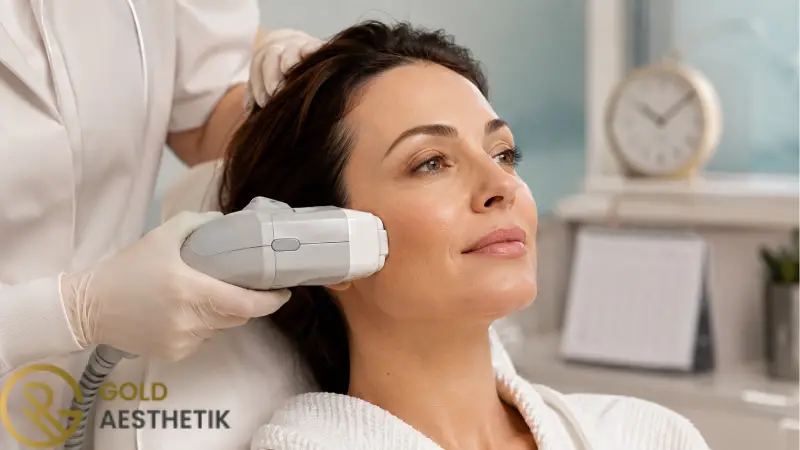
To the question “How long does HIFU last?” there is no credible answer in the form of a fixed number that applies to all patients. The treatment does not stop the natural aging process of the skin. Even with a good individual response, skin, connective tissue, and facial contours continue to change over time.
Longevity therefore depends not only on the treatment itself. Initial skin condition, degree of laxity, tissue quality, treatment area, natural aging, and individual lifestyle factors can influence how long a visible change persists.
Are HIFU Results Permanent?
No. HIFU should not be promoted as a permanent facelift or as a treatment that stops the aging process.
A treatment can improve skin firmness and contour in suitable patients. However, natural aging processes continue afterward. Therefore, appearance can change again over time.
When Does the Effect of HIFU Diminish?
The result does not normally disappear from one day to the next. Rather, the change may gradually become less pronounced over time, while natural skin aging simultaneously progresses.
How quickly this occurs varies individually. Skin quality, age, weight changes, sun exposure, tobacco use, and other personal factors can influence appearance.
Does HIFU Need to Be Repeated Regularly?
A repeat treatment should not automatically follow a fixed schedule. Before another session, it is advisable to first assess the current skin condition and remaining treatment result.
If the skin continues to respond well to treatment and the original treatment goal still exists, another HIFU treatment may be considered for suitable patients. If the initial situation has changed significantly, another method may be more appropriate.
Which Factors Influence HIFU Longevity?
HIFU longevity is influenced by several factors. Even with identical equipment and comparable treatment, two patients can respond differently.
Therefore, technical execution alone is not decisive. Appropriate patient selection and realistic assessment of skin laxity are also important.
Skin Quality and Degree of Skin Laxity
HIFU is primarily considered for mild to moderate skin laxity. With significantly excess or markedly lax skin, the achievable change may be more limited.
Skin thickness, tissue quality, and elasticity can also influence how pronounced the response is. The biological age of the skin is often more relevant than age alone.
| Individual Factor | Possible Influence on Result and Longevity |
|---|---|
| Degree of skin laxity | Influences what degree of tightening is realistic |
| Skin quality | Can influence individual tissue response |
| Aging process | Natural skin aging continues after HIFU |
| Treatment area | Face, jawline, and neck can respond differently |
| Previous treatments | May be relevant for planning and result assessment |
| Personal expectations | Should align with the actual capabilities of the method |
What Role Do Device, Depth, and Energy Settings Play?
The brand name of a HIFU device alone says nothing about individual results. What matters is that treatment depth, energy, and distribution of impulses match the respective area and tissue structure.
More energy does not automatically mean a better result. An inappropriate setting can increase the risk of side effects. Therefore, parameters and treatment plan should be determined individually.
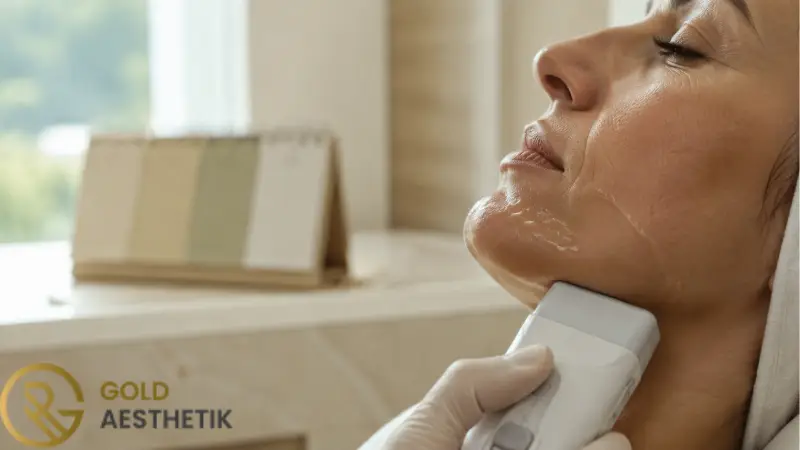
What Role Does the Practitioner’s Experience Play?
HIFU requires knowledge of anatomy and correct assessment of tissue depth. Treatment area, impulse distribution, and intensity should not be chosen identically for every patient.
A medical assessment before treatment also helps clarify whether the main problem is actually skin laxity or whether, for example, volume loss, adipose tissue, or anatomical structures contribute more strongly to appearance.
| Treatment Factor | Significance |
|---|---|
| Selection of treatment area | Only actually suitable areas should be treated |
| Treatment depth | Should match the tissue structure of the respective area |
| Energy setting | Must be chosen individually and safely |
| Distribution of impulses | Influences uniform treatment of the area |
| Anatomical knowledge | Important for proper and safe execution |
| Follow-up examination | Helps assess the result and further steps |
Do Sun, Smoking, and Weight Influence Longevity?
UV radiation and tobacco use can negatively influence overall skin quality and the natural aging process. Consistent sun protection and abstaining from tobacco are therefore sensible measures for skin health independent of HIFU.
Significant weight changes can also alter facial contours and skin tension. Substantial weight loss or gain after HIFU can therefore influence the appearance of the treated area.
These measures can support healthy skin but do not guarantee any specific HIFU longevity.
How Can HIFU Results Be Maintained Most Effectively?
There is no care measure that can guarantee a specific duration of effect. Rather, it is advisable to support overall skin health and follow individual recommendations after treatment.
| Measure | Goal |
|---|---|
| Daily sun protection | Reduction of additional UV-induced skin damage |
| Abstaining from tobacco | Support of overall skin health |
| Stable weight as much as possible | Avoid significant changes in facial contours |
| Skincare appropriate for skin condition | Support of skin barrier |
| Follow-up appointments as needed | Assess development of results more objectively |
Another HIFU treatment should not be performed solely because a certain number of months has passed since the last session. A renewed examination is more appropriate, taking into account skin condition, remaining effect, and current treatment goal.
When Should HIFU Results Be Medically Monitored?
The appropriate time for monitoring depends on the initial situation and treatment plan. An assessment immediately after treatment is usually not very meaningful for the long-term result.
For follow-up examinations, standardized photographs can be helpful. Lighting, camera angle, distance, and facial expression should be as comparable as possible, because different recording conditions can make an effect appear stronger or weaker.
When Should the Practice Be Contacted Earlier?
Temporary redness, tenderness, or mild swelling can occur after an energy-based treatment. However, in case of severe or increasing discomfort, pronounced swelling, persistent numbness, significant skin changes, or other unusual symptoms, medical advice should be sought.
Frequently Asked Questions About HIFU Longevity
How Long Does HIFU Last on the Face?
A fixed duration of effect cannot be stated for all patients. Skin quality, initial findings, treatment area, individual aging, and specific execution influence how long a visible change persists.
When Do You See the Final HIFU Result?
A final assessment immediately after treatment is not advisable. Changes can develop over weeks and months. The course can often be assessed much better after several months.
Is HIFU Permanent After One Session?
No. HIFU does not stop natural skin aging. An achieved tightening effect can become less pronounced again over time.
How Often Can HIFU Be Repeated?
The decision about a repeat treatment should be made individually. Skin condition, previous results, treatment goal, and medical requirements should be reassessed before another session.
Does a More Intensive HIFU Treatment Last Longer?
Not automatically. Higher energy does not necessarily mean a better or longer-lasting result. Settings should be adapted to tissue depth, treatment area, and individual requirements.
For Whom Is HIFU Less Suitable?
With pronounced skin laxity, significant excess skin, or a treatment goal that is not realistically achievable with a non-surgical method, other procedures may be more suitable. Medical and dermatological requirements should also be checked before treatment.
HIFU at Gold Aesthetik Hamburg: Individually Assess Results and Longevity
At Gold Aesthetik, the decision for HIFU treatment is made based on individual initial conditions. These include skin quality, degree of skin laxity, treatment area, medical history, and personal expectations.
The goal of consultation is to realistically assess what degree of change can fundamentally be achieved with HIFU, when the result should be meaningfully evaluated, and whether the treatment is appropriate for the respective skin concern.
Further options for improving skin quality and age-related changes can be found under Skin Rejuvenation and Anti-Aging at Gold Aesthetik.
Gold Aesthetik practice is located at Barmbeker Str. 40, 22303 Hamburg-Winterhude.

