



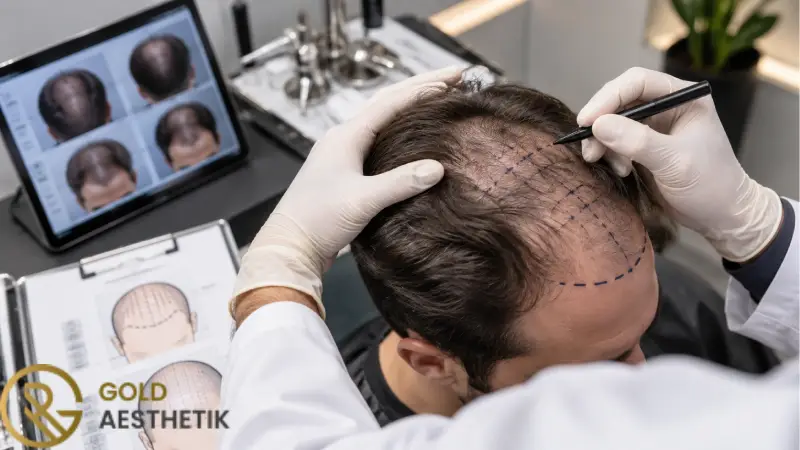
The number of grafts required for a hair transplant cannot be answered with a fixed number for all patients. The number of grafts in a hair transplant depends, among other things, on the extent of hair loss, the size of the recipient area, the existing hair density, the hair structure, the condition of the donor area, and the planned hairline.
A higher number of grafts is not automatically better. The goal of careful planning is to make sensible use of the available donor area, achieve appropriate visual coverage, and at the same time consider reserves for possible future hair loss.
What is a hair graft and why is the number of grafts important in a hair transplant?
Anyone considering a hair transplant quickly encounters the term “graft.” A distinction should be made between hair, hair follicle, and graft. A hair is the visible hair shaft. The hair follicle is located in the skin and forms the hair. In a hair transplant, a graft refers to a follicular unit that has been removed and may contain one or more hairs.
Therefore, the number of grafts does not automatically describe the number of transplanted hairs. It is also crucial how the individual follicular units are composed and where they are implanted.
| Term | Explanation | Significance for Hair Transplantation |
|---|---|---|
| Hair | Visible hair shaft above the skin | Influences visible coverage |
| Hair Follicle | Structure in the skin from which a hair grows | Basis for future hair growth |
| Graft | Removed follicular unit with one or more hairs | Standard unit for planning extraction and implantation |
How many hairs can a graft contain?

A follicular unit can consist of one or more hairs. These differences are taken into account during planning because not every graft is equally suitable for every area of the scalp.
For example, individual hairs can be particularly important for a very fine design of the frontal hairline. Further behind the hairline, follicular units with multiple hairs can contribute to visual coverage. However, the specific distribution should be planned individually.
| Graft Type | Possible Composition | Possible Role in the Treatment Plan |
|---|---|---|
| Single-Hair Graft | One hair | Fine design of visible areas such as the frontal hairline |
| Multi-Hair Graft | Multiple hairs within a follicular unit | Can contribute to more visual coverage in suitable areas |
The composition of grafts differs from patient to patient. Therefore, a specific number of grafts does not automatically imply a fixed number of transplanted hairs.
Why doesn’t the number of grafts alone determine the result?
A common misconception is to automatically equate a higher number of grafts with a better result. However, several factors contribute to the final appearance: quality of the donor area, hair thickness, size of the recipient area, hairline design, distribution of grafts, and implantation direction.
The same number of grafts can produce significantly higher visible coverage on a small area than in cases of widespread thinning. Thicker or wavy hair can also appear visually different from very fine hair.
| Factor | Significance |
|---|---|
| Number of Grafts | Influences the possible extent of coverage |
| Size of the Recipient Area | Determines the area over which grafts must be distributed |
| Hair Structure and Thickness | Influence visible optical density |
| Hairline Design | Shapes the visible appearance of the frontal area |
| Distribution of Grafts | Influences density, transitions, and naturalness |
| Donor Area | Limits the sensibly available number of grafts |
What is more important: graft quality or number of grafts?
Both are interconnected. A sufficient number of suitable grafts is important for the planned coverage, while the health of the donor area should also be considered. Therefore, the highest possible extraction quantity alone is not a meaningful quality criterion.
The donor area represents a limited resource. If possible future hair loss is not considered during planning, subsequent treatment options may be restricted. Therefore, the number of grafts should always be assessed in conjunction with long-term planning and donor capacity.
How is the required number of grafts estimated for a hair transplant?
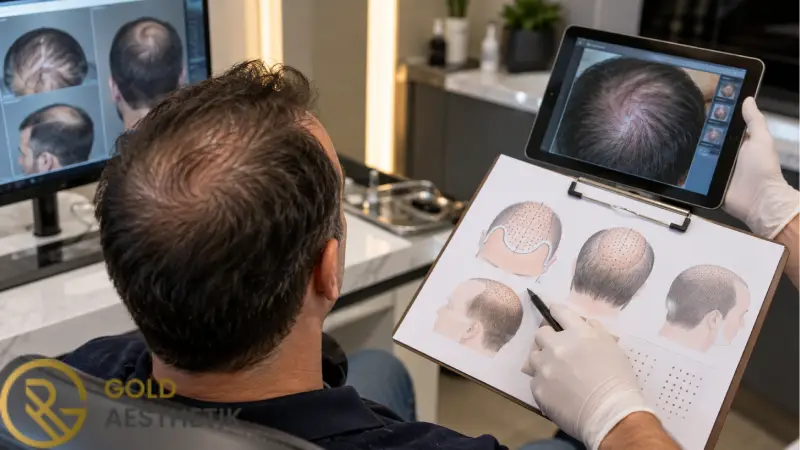
The required number of grafts for a hair transplant is not determined solely by visible baldness. Crucial factors include the size and location of thinning areas, existing residual hair, hair structure, donor capacity, planned hairline, and desired visual coverage.
Online calculators or general tables can at best provide a rough orientation. A more reliable assessment requires evaluating both the donor and recipient areas.
Why isn’t a simple formula sufficient?
Fundamentally, the logic of graft estimation can be simplified as a ratio between the treatment area and the desired density. In actual planning, however, such a calculation is significantly more complex.
The hairline, frontal area, mid-scalp, and crown have different requirements for design and distribution. Existing natural hair also changes the actual need. A uniform target density for the entire scalp would therefore be too imprecise.
How is the graft requirement planned for the hairline and frontal area?
The frontal hairline is one of the most visible areas of a hair transplant. Its shape should match facial proportions, age, hair structure, and the possible future course of hair loss.
A very deeply planned hairline can enlarge the area to be treated and consequently require more donor capacity. Therefore, the hairline should not be planned solely based on a current wish, but should also appear sensible in the long term.
| Area | Important Factors for Graft Planning |
|---|---|
| Hairline | Shape, width, existing hair, and finest possible transitions |
| Temples | Growth direction, angle, and harmonious transition to the hairline |
| Frontal Area | Area, residual hair, and desired visual coverage |
| Mid-Scalp | Extent of thinning and existing natural density |
| Crown | Size of the area and natural swirl pattern |
How does the extent of hair loss affect the number of grafts?
As the size of the thinning area increases, the need for careful distribution of available grafts generally rises. With limited hair loss, treatment can focus on the hairline or temples, for example, while with advanced thinning, multiple scalp areas must be considered.
For larger bald areas, it is not always sensible or possible to treat every area with maximum density. Depending on donor capacity, prioritizing the most visually important zones may be necessary.
| Extent of Hair Loss | Possible Situation | Typical Planning Approach |
|---|---|---|
| Limited | Hairline or individual temple areas affected | Targeted reconstruction of visible areas |
| Moderate | Frontal area additionally thinned | Distribution of grafts considering existing hair |
| Pronounced | Multiple scalp areas affected | Prioritization according to donor capacity and desired coverage |
| Very Pronounced | Large recipient area with limited donor reserve | Conservative long-term planning and, if necessary, multi-stage treatment |
Can the number of grafts be determined from photos?
Photos can be helpful for an initial orientation, but are usually not sufficient for a precise determination. For example, actual donor density, hair thickness, composition of follicular units, and safe extraction capacity can only be assessed to a limited extent from images.
For an initial assessment, photos from the front, top, sides, back of the head, and crown can provide additional information. However, the final planning should be based on a medical evaluation of the donor and recipient areas.
Which factors change the required number of grafts?
Two patients with seemingly similar hair loss do not necessarily require the same number of grafts. Differences in hair thickness, existing hair density, donor capacity, size of the recipient area, hair structure, and long-term hair loss pattern can significantly alter the treatment plan.
Extent of baldness and existing hair density
The larger the area to be treated, the more grafts may generally be required. Existing healthy hair in the recipient area, however, can contribute to needing fewer additional grafts for satisfactory visual coverage.
| Factor | Possible Influence on Planning | Why? |
|---|---|---|
| Larger Recipient Area | Higher graft requirement possible | More area needs to be covered |
| Existing Residual Hair | Lower additional requirement possible | Part of the visible density is already present |
| Higher Desired Density | Can increase graft requirement | More follicular units must be distributed over the same area |
| Thicker or Wavy Hair | Can create more visual coverage | The scalp may appear less visible |
| Very Fine Hair | May require a different distribution strategy | The visual coverage will be different |
| Limited Donor Area | Restricts the number of extractable grafts | The donor area should be preserved as much as possible |
Strength, Quality, and Capacity of the Donor Area
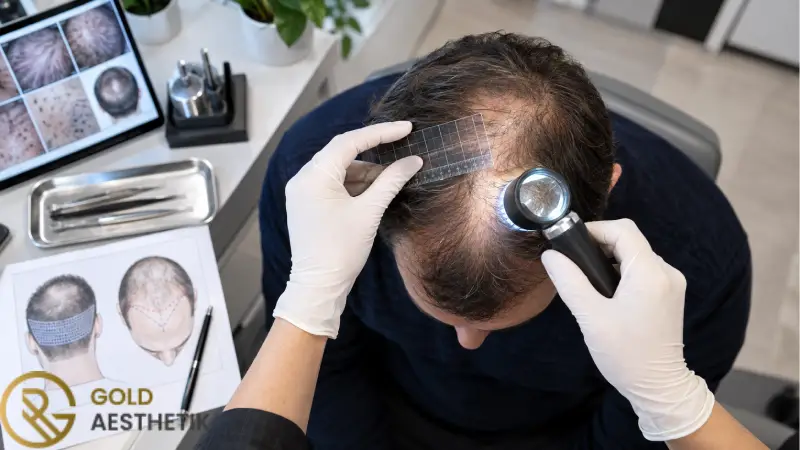
The donor area is usually assessed in terms of density, hair structure, distribution of follicular units, and the size of the zone suitable for extraction. These factors determine how many grafts are sensibly available.
The goal should not be to extract the maximum technically possible number. An overly aggressive extraction can visibly thin the donor area and limit future treatment options.
| Donor Area | Possible Characteristics | Possible Planning Approach |
|---|---|---|
| Limited Capacity | Lower density or smaller suitable extraction zone | Prioritization of important recipient areas and conservative extraction |
| Medium Capacity | Sufficient density and suitable follicles | Planning according to hair loss and treatment goal |
| Favorable Conditions | Good density and suitable hair structure | More flexibility in distribution possible |
This classification is for illustrative purposes only. The actual capacity of the donor area must be assessed individually for each patient.
How do hair thickness and hair structure influence graft requirements?
Hair structure influences how much the scalp remains visible between the hairs. Thicker or wavy hair can create a different visual coverage with the same number of grafts than very fine, straight hair.
The contrast between hair color and scalp can also influence how pronounced thinning is visually perceived. Therefore, the pure number of grafts is not a sufficient measure for the expected visible density.
What role does the desired density play?
Personal ideas about hair density also factor into planning. However, the desired density must be compatible with the capacity of the donor area and the size of the area to be treated.
If a very high density is desired over a large area, but the available donor capacity is limited, priorities may be necessary. Often, particularly visible areas such as the hairline and front are given greater consideration.
Why must future hair loss be considered?
In cases of progressive hair loss, a hair transplant should not only be planned for the current condition. If natural hair loss continues in the coming years, new thinning areas may emerge.
Age alone is not a sufficient measure for this. Previous course, hair loss pattern, family history, existing miniaturized hairs, and donor capacity can also be relevant for long-term planning.
Does a higher number of grafts automatically lead to a better result?
No. The most sensible number of grafts is not automatically the largest possible number. It should match the recipient area, hair structure, planned density, and donor area capacity.
A natural-looking result depends on several factors: hairline design, distribution, implantation direction, graft characteristics, existing hair, and long-term planning must all work together.
How is the Number of Grafts Determined at Gold Aesthetik Hamburg?
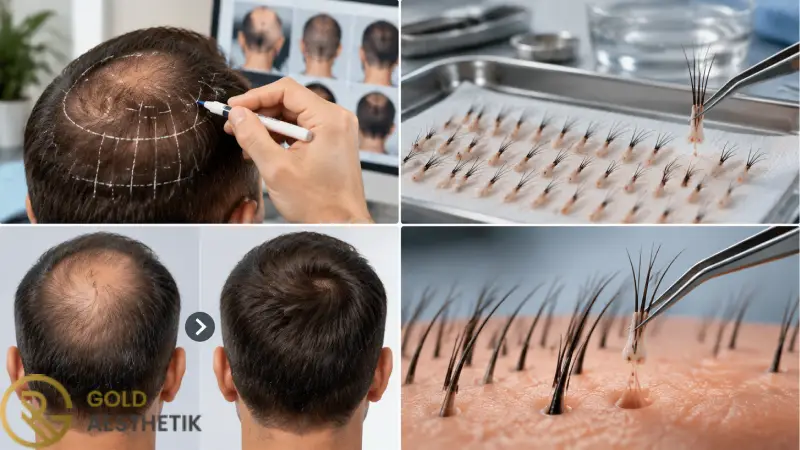
At Gold Aesthetik, the required number of grafts is assessed based on the individual initial situation. This includes, among other things, the extent and pattern of hair loss, the size of the recipient area, existing hair density, hair structure, and the capacity of the donor area.
Hairline design and long-term development should also be included in the planning. A particularly high number of grafts without considering the actual donor capacity is not a meaningful quality criterion.
Only after assessing these factors can a more realistic estimate be made of how many grafts may be sensible for the individual treatment plan and which areas should be prioritized.
The Gold Aesthetik clinic is located at Barmbeker Str. 40, 22303 Hamburg-Winterhude.

