



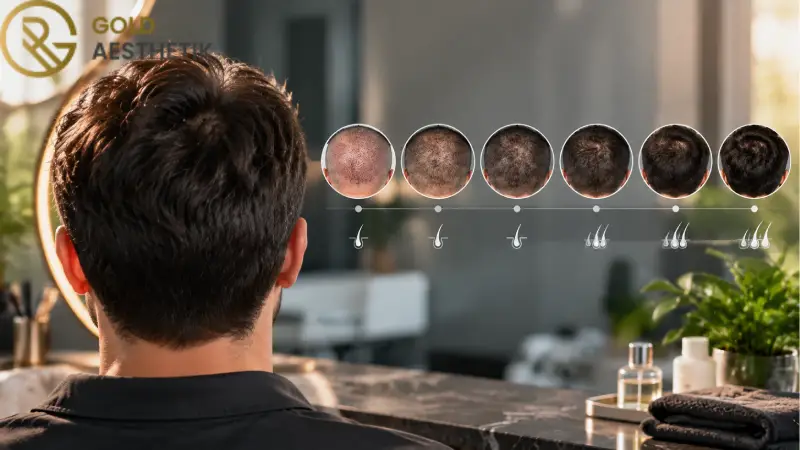
The hair growth after hair transplantation progresses gradually and cannot yet be reliably assessed in the first weeks. Immediately after the procedure, the healing of the scalp and the stabilization of the transplanted grafts are the primary focus. Subsequently, the visible hair shafts may partially fall out before new hair growth gradually begins after a resting phase.
How quickly this process progresses varies individually. Donor area, hair structure, size of the transplanted area, condition of the scalp, healing process, and other personal factors can influence when new hair becomes visible and how density develops in the following months.
Hair Growth After Hair Transplantation in the First Weeks: What Happens to the Grafts?
The first weeks after a hair transplantation belong to the early healing phase. During this time, redness, mild swelling, small crusts, a feeling of tightness, or itching may occur. A later loss of some of the transplanted hair shafts may also be part of the normal course.
During this phase, visible hair density should not yet be evaluated. More important is caring for the treated scalp according to individual medical instructions and avoiding unnecessary pressure, friction, or manipulation in the transplanted area.
Day 1 to Day 7 After Hair Transplantation
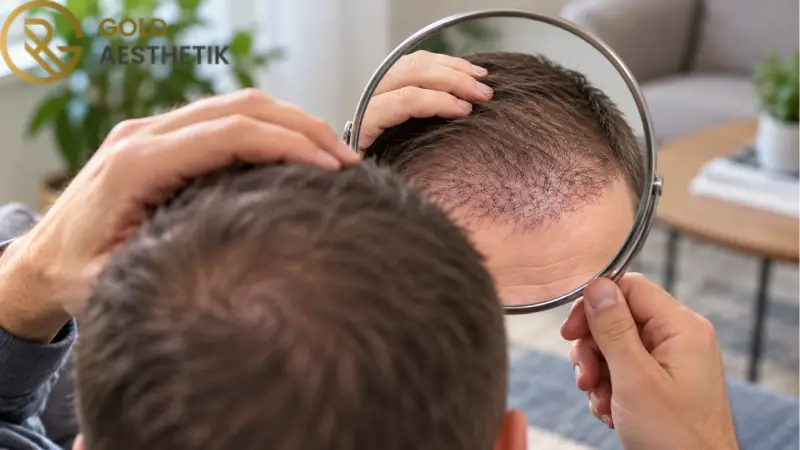
In the first days, the freshly transplanted grafts are particularly sensitive to mechanical stress. Direct pressure, scratching, and vigorous rubbing should therefore be avoided. Mild redness, small crusts, or temporary swelling may occur and do not automatically indicate a complication.
Hair washing should also follow the specific aftercare instructions from the treating practice. Timing, frequency, and type of cleansing may vary depending on the treatment, skin condition, and individual healing process.
| Period | Possible Graft Condition | Possible Appearance | Important Note |
|---|---|---|---|
| Day 1 to 2 | Early stabilization phase | Redness, small dots, or mild swelling possible | Avoid unnecessary pressure and direct contact |
| Day 3 to 4 | Healing progresses | Small crusts and mild itching possible | Do not scratch off crusts independently |
| Day 5 to 7 | Grafts increasingly stabilized | Redness and swelling may subside | Continue care according to medical guidance |
Week 2: Scalp Healing and Reduction of Crusts
In the second week, the scalp increasingly calms down in many patients. Redness and crusts may gradually subside. However, the exact course is not the same for everyone and depends on factors including skin type, treatment scope, and individual wound healing.
Crusts should not be forcibly removed. The return to sports, intensive physical exertion, or other activities should also be guided by personal healing progress and the recommendations of the treating practice.
| Period | Possible Hair Condition | Possible Scalp Condition | Classification |
|---|---|---|---|
| Week 1 | Transplanted hair shafts still visible | Redness and crusts possible | Early healing phase |
| Week 2 | Externally initially relatively stable | Crusts may significantly decrease | Healing continues |
| Week 3 | First loss of transplanted hair shafts possible | Scalp usually significantly calmer | May be part of the normal course |
| Week 4 | Visible density may temporarily decrease | Scalp approaches baseline condition | Still too early for result evaluation |
Why Can Transplanted Hair Fall Out in Weeks 3 and 4?
In the first weeks, some of the visible transplanted hair may fall out. This process often affects primarily the hair shaft, while the transplanted follicle remains in the skin. A resting phase may then follow before a new growth cycle begins.
A temporary decrease in visible density therefore does not automatically mean that the transplantation has failed. The first weeks are not a suitable time to assess the later result.
Is Hair Loss in the First Month a Sign of a Poor Result?
No, temporary loss of the transplanted hair shafts may occur in the first weeks. The appearance in the first month is therefore normally not a reliable measure of the later result.
The transplanted follicles need time to re-enter an active growth cycle after treatment. Direct comparison with photos of other patients can also be misleading because healing and hair growth progress individually.
What Changes Are Common in the First Weeks and When Should Medical Consultation Be Sought?
Mild redness, small crusts, temporary itching, and some loss of transplanted hair shafts may occur during the early healing phase. However, severity and duration differ from person to person.
Severe or increasing pain, fever, purulent discharge, unusual bleeding, or significantly increasing inflammation should, however, be medically assessed. General information about the usual healing process does not replace individual medical examination in case of noticeable symptoms.
| Observation | Can Occur in Normal Course? | When Is Medical Clarification Advisable? |
|---|---|---|
| Small crusts | Yes, especially in the early healing phase | In case of discharge, severe inflammation, or unusual course |
| Mild itching | May occur | If it is severe or significantly increases |
| Loss of transplanted hair shafts | May occur in the first weeks | In case of additional noticeable symptoms |
| Mild swelling | May occur especially early | If it is severe, increasing, or persistent |
| Severe pain, fever, or purulent discharge | Not to be classified as normal course | Prompt medical clarification recommended |
Hair Growth After Hair Transplantation from Month 1 to 4: Shedding and New Beginning
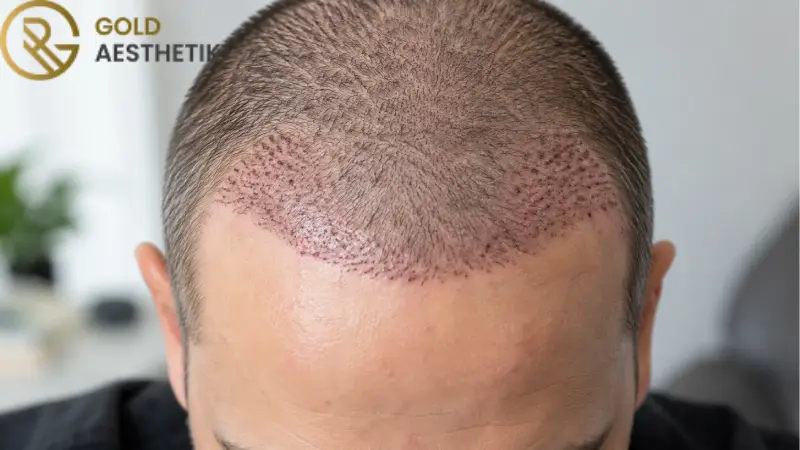
The period between the first and fourth month is for many patients a phase with relatively few visible changes. Some of the transplanted hair shafts may have already fallen out, while new hair growth is not yet clearly visible.
This phase should not be prematurely interpreted as treatment failure. Transplanted follicles may temporarily enter a resting phase after the procedure. Subsequently, individual follicles begin forming new hair at different times.
What Does Shedding or So-Called Shock Hair Loss Mean?
Shedding refers to the temporary loss of visible transplanted hair shafts after hair transplantation. Colloquially, this is often also referred to as shock hair loss.
Important is the distinction between a falling hair shaft and the actual loss of a transplanted follicle. In many cases, the follicle remains in the skin and can form hair again after a resting phase.
| Month | Possible Phase | Visible Hair Appearance | Realistic Classification |
|---|---|---|---|
| Month 1 | Beginning of a resting phase in some follicles | Density may temporarily decrease | Clearly too early for result evaluation |
| Month 2 | Resting phase may continue | Transplanted area may appear relatively sparse | Little visible growth may occur |
| Month 3 | New growth may begin in some follicles | First fine and short hair possible | Follicles do not grow simultaneously |
| Month 4 | Increasing growth activity possible | New hair may become more noticeable | Result is still in an early phase |
Month 2: Why Is Often Little Growth Visible?
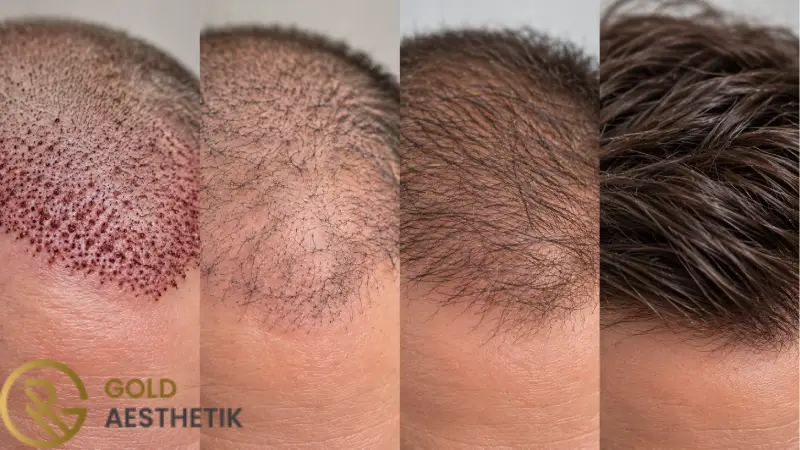
In the second month, the transplanted area may appear particularly unspectacular visually. Many of the originally visible hair shafts may have already fallen out, while new growth is not yet sufficiently advanced to show noticeable densification.
This condition should not be confused with the final result. The follicles are in different biological phases, so no reliable statement about the later result is possible based on the second month.
| Change | Possible Period | Classification |
|---|---|---|
| Loss of transplanted hair shafts | First weeks | May be part of the normal course |
| Temporarily lower visible density | Month 1 to 2 | May result from shedding and resting phase |
| First fine regrowth | Possible from the following months | Onset is individually different |
| Loss with severe pain or inflammation | Possible at any time | Medical clarification advisable |
Month 3: First New Hair May Become Visible
From the following months, first new hair may become visible in some patients. These are initially often fine, short, and not evenly distributed.
Not all transplanted follicles begin growing simultaneously. Therefore, part of the recipient area may already show new hair while other areas still show little change.
Month 4: Is Hair Growth Already Complete Now?
Even in the fourth month, the result is normally still developing. In some patients, new growth becomes more noticeable now, while in others visible changes occur more slowly.
The newly grown hair may initially appear thinner. In the coming months, additional follicles may enter the growth phase and already visible hair may increase in length and strength.
Why Does Growth Progress Differently in Each Patient?
There is no timeline for hair growth after a transplantation that proceeds exactly the same in all patients. Hair cycle, donor area, hair structure, size of recipient area, skin condition, healing, and other individual factors can influence the visible course.
| Factor | Possible Influence |
|---|---|
| Individual hair cycle | Influences the time at which individual follicles become active again |
| Hair structure and strength | Influence how quickly visible coverage develops |
| Donor area | Characteristics of transplanted follicles differ individually |
| Scalp condition | May influence healing process |
| Aftercare | Important for protecting the treated area in the early healing phase |
Hair Growth After Hair Transplantation from Month 5 to 12: When Does the Result Become Visible?
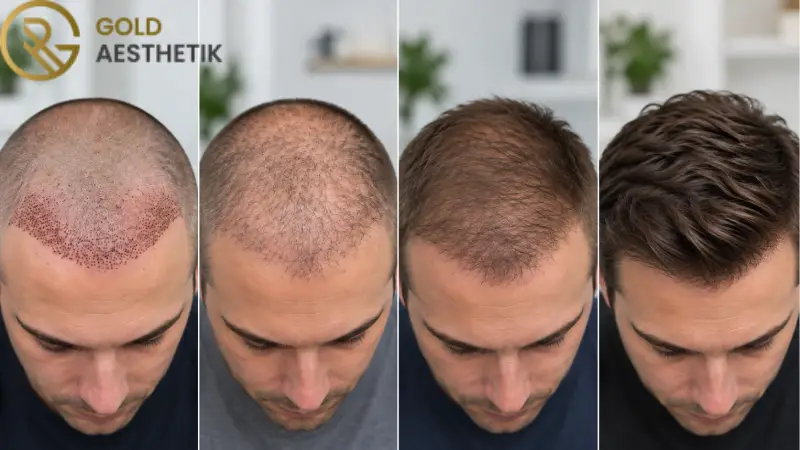
From the middle months, visible changes often become more noticeable. New hair may become longer and stronger and coverage of the transplanted area may gradually increase.
Even at this time, however, it should not be assumed that the final result has already been achieved in every patient. The maturation of transplanted hair progresses individually and may continue over many months.
Month 5 and 6: More Visible Growth
In the fifth and sixth months, increasingly new hair may become visible. Already grown hair may increase in length and strength and the appearance of the recipient area begins to change more noticeably.
After six months, the general course can be better assessed in many patients. However, this time is often still too early for a final evaluation of density and hair thickness.
| Period | Possible Visible Development | Realistic Expectation |
|---|---|---|
| Month 5 | More new hair may become visible | Density and hair thickness still developing |
| Month 6 | Coverage may become more noticeable | Course more assessable but not yet final |
| Month 7 to 9 | Further increase in length, strength, and visible density possible | Overall appearance becomes increasingly informative |
| Month 10 to 12 | Maturation and densification may continue to progress | More accurate assessment of result possible |
Month 7 to 9: Density and Hair Thickness Continue to Develop
Between the seventh and ninth months, changes may increasingly be visible not only in the number of visible hair but also in their strength. This can make the transplanted area appear optically denser.
The hairline may also appear more harmonious with increasing length and maturation of the hair. However, the exact timing of these changes is individually different.
Month 10 to 12: When Is a More Accurate Assessment Possible?
Toward the end of the first year, the result can be assessed much better in many patients than in the early months. More follicles have had time for new growth and already grown hair has been able to develop further.
The twelfth month is nevertheless not a rigid boundary. Depending on the treated area, hair structure, and individual course, changes in hair thickness, length, or visible density may still occur thereafter.
| Time Point | Visible Growth | Assessment of Result |
|---|---|---|
| 6 months | Already visible in many, but not yet fully developed | Good progress monitoring possible, final evaluation usually too early |
| 9 months | Often more noticeable density and more mature hair | Result increasingly assessable |
| 12 months | Significantly advanced in many patients | More accurate overall assessment possible |
How Well Can the Result Be Assessed After Six Months?
After six months, it can often be assessed whether new growth has begun and how hairline and coverage are fundamentally developing. However, more time is usually required for a final judgment on density or treatment success.
It is therefore not sensible to directly compare a patient’s result after six months with the twelve-month results of other individuals.
When Does the Hairline Appear More Natural?
The appearance of the hairline does not depend solely on how many transplanted follicles grow. Hair thickness, length, growth direction, and coordination with existing natural hair also influence the overall impression.
In the first growth months, new hair may still be fine or of varying length. With increasing maturation, the appearance may become more uniform and natural.
What Factors Influence Hair Growth After Hair Transplantation?
Time alone does not determine how quickly a result becomes visible. Even in two patients treated on the same day, growth speed, visible density, and maturation may progress differently.
Quality and Capacity of the Donor Area
The donor area is an important foundation of transplantation planning. Hair density, hair strength, distribution, and number of suitable follicles influence what coverage can realistically be planned in the recipient area.
The highest possible extraction quantity should not be the sole goal. The treatment plan should consider both the desired coverage and the preservation of a harmonious donor area.
Size and Location of the Transplanted Area
The larger the area to be treated, the more important careful distribution of available grafts becomes. The total number alone does not determine the later appearance.
Hairline, growth direction, existing residual hair, and individual hair structure should also be considered in planning.
Transplantation Technique and Handling of Grafts
The method used may influence individual steps of extraction or implantation. However, the name of a technique alone does not determine how quickly hair grows later or how the final result turns out.
Careful treatment includes, among other things, appropriate extraction, proper handling of grafts, suitable implantation direction, and a design tailored to the individual initial situation.
Aftercare Following Hair Transplantation
Aftercare is particularly important in the first days to protect the treated area and support the healing phase. Hair washing, physical exertion, sleeping position, and any prescribed medications should follow individual medical instructions.
Medications, dietary supplements, or topical preparations should not be used solely based on general recommendations found online. Whether an application is sensible depends on the personal medical situation and treatment plan.
When Should Hair Growth Progress Be Medically Monitored?
Slow growth in the first months does not automatically mean a problem exists. Assessment should always consider the time since transplantation and the individual initial situation.
In case of increasing pain, significant inflammation, fever, unusual discharge, noticeable bleeding, or other symptoms, however, prompt contact with the treating practice or a physician should be made.
Even in case of uncertainty about growth progress in later months, a follow-up examination may be advisable. Initial findings, transplanted area, donor area, and development since the procedure can be assessed together.
Summary: Hair Growth After Hair Transplantation from Week 1 to Month 12
Hair growth after hair transplantation progresses in several phases. In the first days, healing and protection of the grafts are the priority. In the following weeks, transplanted hair shafts may partially fall out and the recipient area may temporarily appear sparser.
In the first months, little new growth is often visible. Subsequently, new hair may gradually appear, become longer and stronger, and lead to increasing visible density. After approximately six months, the course can often be better assessed, while significantly more time is usually required for a more accurate evaluation of the result.
The temporal course is not identical in every patient. Donor area, hair structure, transplantation scope, scalp condition, treatment, and individual healing and growth processes can influence when changes become visible.
Follow-Up Monitoring After Hair Transplantation at Gold Aesthetik Hamburg

At Gold Aesthetik, a hair transplantation is planned based on the individual initial situation. This includes, among other things, donor area, hair loss pattern, desired transplantation area, and personal requirements.
Even after the procedure, growth progress can be assessed as part of a medical examination. This allows classification of whether observed changes correspond to the respective stage of the healing and growth process or whether further clarification is advisable.
The Gold Aesthetik practice is located at Barmbeker Str. 40, 22303 Hamburg-Winterhude. If you would like to have your donor area, a possible hair transplantation, or the progress after an already completed treatment assessed, you can request a consultation via the Gold Aesthetik contact page or get in touch at +49 170 1732608.

