



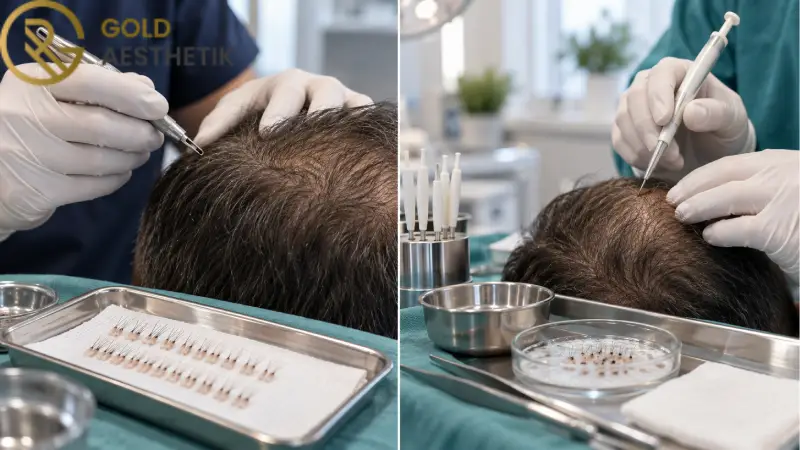
FUE or DHI – which method is better suited for a hair transplant? This question cannot be answered in general terms. Both terms describe different technical aspects of a hair transplant, and the appropriate approach depends, among other things, on the donor area, the hair loss pattern, the number of grafts required, the existing hair, and the planned recipient area.
It is also important to note: DHI is not a method completely separate from FUE in every phase. In many DHI treatments, the follicular units are also extracted individually from the donor area. The main difference often lies in the way the recipient area is prepared and the grafts are subsequently implanted.
FUE or DHI: What Is the Most Important Difference?
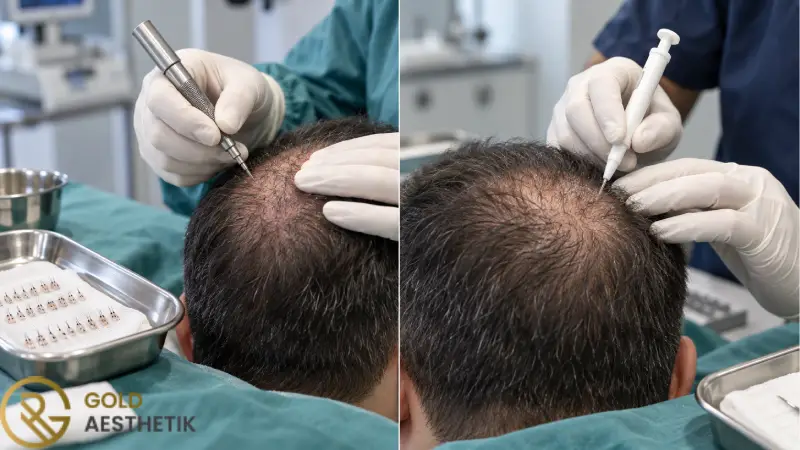
To compare FUE and DHI meaningfully, the hair transplant process should be divided into individual steps. First, the donor area, hair loss pattern, hair structure, and recipient area are assessed. Subsequently, suitable follicular units are extracted and prepared for implantation.
In a classic FUE treatment, the planned openings or channels are usually created in the recipient area first. The grafts are then inserted according to the intended density, growth direction, and hairline.
In DHI, implantation typically takes place using a so-called implanter pen. The graft is loaded into the instrument and then inserted into the planned area. The name DHI therefore refers primarily to the type of implantation and not necessarily to a fundamentally different extraction technique.
| Treatment step | FUE | DHI |
|---|---|---|
| Preliminary examination | Assessment of donor area, hair loss, and recipient area | Assessment of donor area, hair loss, and recipient area |
| Extraction of grafts | Individual follicular units are extracted | Extraction is also FUE-based in many treatment protocols |
| Preparation of the recipient area | Channels or implantation sites are prepared before insertion | Implantation typically takes place with an implanter pen |
| Insertion of grafts | Grafts are inserted into the prepared sites | Grafts are placed with the implanter pen |
| Choice of method | Should be based on the individual initial situation and not solely on the name of the method | |
How are follicles extracted in FUE and DHI?
In FUE, follicular units are extracted individually from a suitable donor area. This is often located at the back or side of the head. Fine instruments are used for extraction to loosen the individual grafts from the skin.
In DHI, the extraction of grafts also often follows the same or a comparable principle. Therefore, it is inaccurate to present FUE and DHI as two procedures that are completely different in all treatment steps.
For both approaches, the selection of the donor area, a controlled distribution of the extraction sites, and careful handling of the follicular units are important. How many grafts can be extracted depends on the individual conditions of the donor area.
How do preparation and implantation in the recipient area differ?
In the classic FUE technique, the desired hairline is planned and it is then determined where the individual grafts should be inserted. The angle, direction, and distribution must match the natural growth direction and the respective region of the head.
In DHI, the prepared grafts are inserted into an implanter pen and then implanted into the recipient area. This technique can support controlled placement in certain situations, for example, in limited treatment areas or when working between existing hair.
However, the use of an implanter pen does not automatically guarantee higher density, a more natural result, or better growth of the grafts. Treatment planning, donor area, hairline design, implantation direction, and careful handling of the grafts remain crucial.
Is DHI more modern or better than FUE?
Terms like “more modern” or “better” can give the impression that a certain method is superior for all patients. Such a generalized statement is not medically sound.
For one patient, classic FUE planning may be well-suited for the desired area, while for another patient, implantation with an implanter pen may seem appropriate. The decisive factors are the actual conditions and the treatment goal.
| Comparison point | FUE | DHI |
|---|---|---|
| Extraction | Individual extraction of follicular units | In many cases, also individual extraction of follicular units |
| Implantation | Insertion into previously prepared implantation sites | Insertion with an implanter pen |
| Control of direction and angle | Via planning and creation of the implantation sites | Via planning and positioning of the pen |
| Suitable scope of treatment | Depending on graft count and donor capacity | Depending on donor area, existing hair, and recipient area |
| Decisive factor | Individual assessment and professional execution | |
FUE or DHI: Which Method Enables the Better Result?
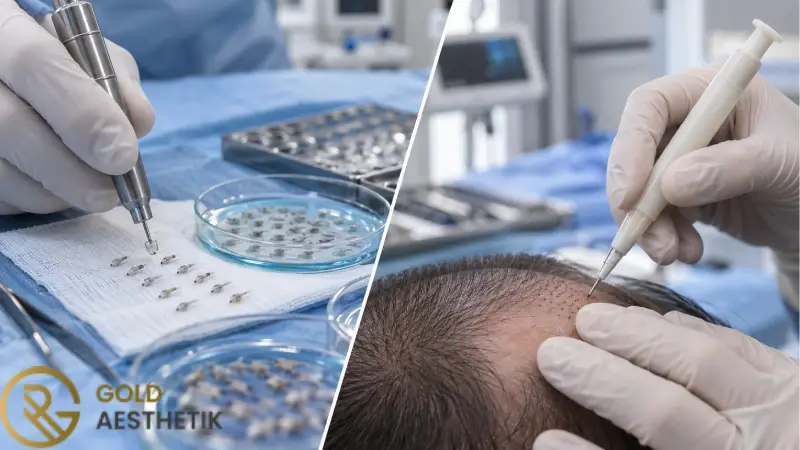
The later result of a hair transplant cannot be predicted solely by the designation FUE or DHI. With both approaches, natural results can be aimed for under suitable conditions.
Relevant factors for the result include the quality and capacity of the donor area, hair structure, graft selection, size of the recipient area, hairline design, implantation angle, and future natural hair loss.
Which method enables higher density?
High density is not achieved solely by inserting as many grafts as possible into a small area. The possible density depends on donor capacity, existing hair, size of the recipient area, and individual tissue properties.
A targeted distribution of grafts can be planned with both FUE and DHI. However, an implanter pen does not automatically increase the number of available grafts and cannot compensate for a limited donor area.
| Comparison criterion | FUE | DHI |
|---|---|---|
| Treatment of larger areas | Can be planned depending on graft count and donor capacity | Fundamentally possible, choice of method depends on the individual case |
| Implantation between existing hair | Possible with precise planning | Implanter pen can be helpful in selected situations |
| Density | Depending on graft count, distribution, and recipient area | Also depending on graft count, distribution, and recipient area |
| Main limitation | Donor capacity and individual requirements | Donor capacity and individual requirements |
Which method enables a more natural hairline?
The naturalness of a hairline depends more on its design and the selection and distribution of the grafts than on the name of the technique used.
In the front area, individual fine grafts can help create a soft transition. Further back, suitable multi-hair follicular units can be used to support visual coverage.
In FUE, angle and direction are controlled via the planned implantation sites. In DHI, the position and direction of the implanter pen must also be adapted to the natural growth pattern. Both methods therefore require precise planning.
| Factor for a natural hairline | Significance |
|---|---|
| Individual hairline planning | The shape should match the face, age, and hair loss pattern |
| Selection of suitable grafts | Finer units can be important for visible transitions |
| Implantation angle | Should be oriented towards the natural growth direction |
| Distribution of grafts | Influences visual density and transitions |
| Long-term planning | Possible future hair loss should be taken into account |
Does the durability differ between FUE and DHI?
The durability of transplanted hair cannot be assessed solely on the basis of the FUE or DHI method. Both procedures use transplanted follicular units whose later growth depends on various individual and treatment-related factors.
Natural hair around the transplanted area can also continue to be affected by the original hair loss. Long-term planning should therefore not exclusively take into account the currently bald areas.
For whom can FUE or DHI be better suited?
The question of whether FUE or DHI is better suited should be answered after an examination. Two patients with hair loss that appears similar can differ significantly in terms of donor density, hair structure, existing hair, and long-term loss pattern.
Large recipient areas and higher graft requirements
In the case of a larger thinned area, it should first be assessed how many suitable grafts can be extracted from the donor area and how these can be meaningfully distributed over the recipient area.
The decision for a specific implantation technique should not be considered in isolation in such cases. The available donor capacity and a long-term meaningful graft distribution are often more important than the name of the method.
Transplantation between existing hair
If there is still a lot of natural hair in the recipient area, the implantation must be planned particularly carefully. The goal is to place the grafts between the existing hair and to avoid unnecessary stress on existing follicles as much as possible.
In selected situations, the DHI implanter can be an option for this type of placement. However, transplantation between existing hair is also possible with FUE if recipient sites are planned accordingly.
Donor area and long-term hair loss
The condition of the donor area is crucial for both methods. Density, hair thickness, composition of the follicular units, and a possible previous hair transplant can influence the number of available grafts.
Future progressive hair loss should also be taken into account. If too many grafts are used exclusively for the currently visible situation, future treatment options may be limited.
| Initial situation | Important planning aspect |
|---|---|
| Large thinned area | Donor capacity and meaningful distribution of grafts |
| Lots of existing hair in the recipient area | Precise implantation between existing follicles |
| Correction of the hairline | Selection of suitable grafts, direction, and implantation angle |
| Limited donor area | Conservative long-term planning |
| Previous hair transplant | Re-assessment of donor and recipient area |
FUE or DHI: Differences in healing, risks, and aftercare
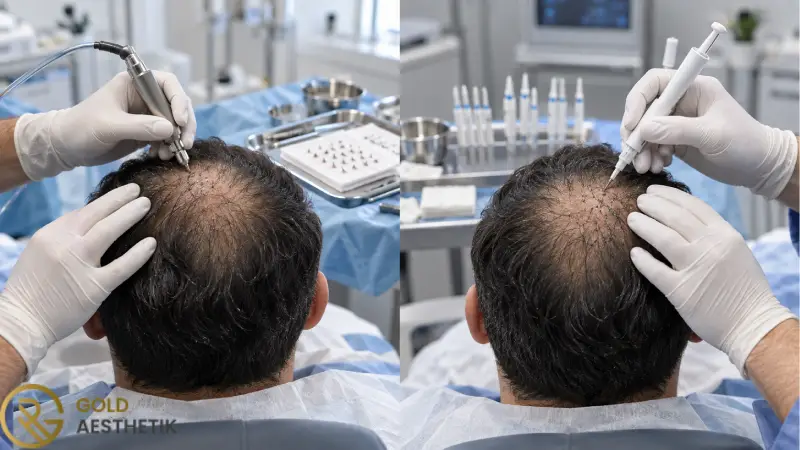
The healing process does not only depend on whether FUE or DHI was used. The number of transplanted grafts, the size of the donor and recipient areas, skin condition, and individual reaction to the procedure can also play a role.
Both approaches are medical procedures. Careful aftercare is therefore important regardless of the chosen implantation technique.
How does healing proceed?
In the first few days, redness, slight swelling, small crusts, or sensitivity may occur. How pronounced these changes are and how long they last differs individually.
Since the extraction of grafts in DHI often also follows the principle of individual extraction, the donor area must heal in both approaches. Differences mainly concern the preparation and implantation in the recipient area.
| Healing aspect | FUE | DHI |
|---|---|---|
| Donor area | Healing of the individual extraction sites | Healing of the individual extraction sites |
| Recipient area | Healing of the implantation sites | Healing of the implantation sites |
| Redness and crusts | Can occur in the early phase | Can occur in the early phase |
| Return to everyday life | Depending on the scope of treatment and individual progress | Depending on the scope of treatment and individual progress |
What symptoms can occur after treatment?
After a hair transplant, sensitivity, redness, swelling, itching, or crusts may occur temporarily. These symptoms cannot be reliably predicted solely on the basis of the designation FUE or DHI.
Severe or increasing pain, fever, purulent secretion, unusual bleeding, or significantly increasing redness should be medically clarified.
Does aftercare differ between FUE and DHI?
Many basic principles of aftercare are comparable. In the early healing phase, unnecessary pressure, scratching, and friction in the recipient area should be avoided.
When hair washing, sports, swimming pool, sauna, or other activities are sensible again should be decided according to the individual instructions of the treating practice. Medications and topical products should also only be used according to medical recommendation.
| Aftercare | FUE | DHI |
|---|---|---|
| Hair washing | According to individual aftercare plan | According to individual aftercare plan |
| Protection of the grafts | Avoid pressure and friction | Avoid pressure and friction |
| Sports | Resumption after medical recommendation | Resumption after medical recommendation |
| Crusts | Do not remove forcibly on your own | Do not remove forcibly on your own |
| Medication | Only according to individual medical instruction | Only according to individual medical instruction |
FUE or DHI: Which Method Is Better?
There is no generalized answer to the question “FUE or DHI – which is better?”. The decisive difference lies primarily in certain steps of the implantation. Which approach is more sensible depends on the individual initial situation.
In the case of large-scale hair loss, donor capacity and graft distribution can be particularly important. If there is still a lot of natural hair in the recipient area, however, precise placement between existing hair can come more to the fore.
Hairline design, protection of the donor area, handling of the grafts, implantation direction, and the possible future development of hair loss should be taken into account with both methods. Advertising claims such as “guaranteed thicker”, “painless”, or “always better” are not a suitable basis for choosing a method.
Consultation on the choice between FUE and DHI at Gold Aesthetik Hamburg
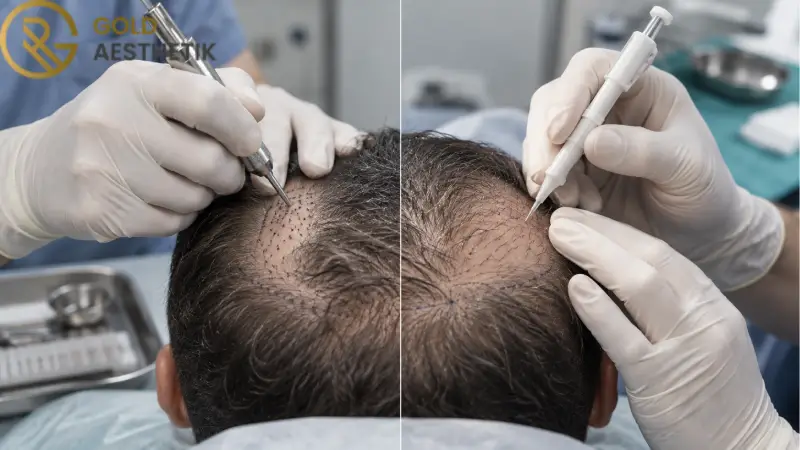
At Gold Aesthetik, the choice of hair transplantation method is assessed based on the individual initial situation. Factors such as hair loss pattern, recipient area, condition and capacity of the donor area, hair structure, existing hair, and the desired treatment goal can be taken into account.
Only after this assessment can a sensible decision be made as to which approach appears suitable for the respective treatment plan. The focus should not be on the name of a specific technique, but on planning that fits the individual medical and anatomical situation.
The Gold Aesthetik practice is located at Barmbeker Str. 40, 22303 Hamburg-Winterhude. If you would like to have your donor area examined and discuss the possible methods of a hair transplant, you can request a consultation via the Gold Aesthetik contact page or get in touch at +49 170 1732608.

