




The longevity of a thread lift is not a fixed value for everyone. The type and design of the threads, the quality and thickness of the skin, the degree of sagging, the treatment area, the thread placement, and individual conditions can all influence the duration of the visible result. For many people, the visual change is recognizable for about 1 to 2 years; however, it can be shorter or longer, and no specific timeframe can be guaranteed without an examination.
It is important to note: The resorption time of the threads is not identical to the longevity of the result. Resorbable threads are gradually broken down by the body, but the tissue reaction and changes along the path of the thread can mean that part of the visual improvement remains even after resorption begins. At the same time, natural skin aging and sagging continue to progress; therefore, a thread lift is not considered a permanent treatment.
Longevity of the thread lift and timing of the final result
During a thread lift, resorbable threads are placed under the skin along planned lines to support and limitedly reposition the tissue in a specific direction. Part of the change may be visible immediately after the treatment, but this early appearance should not be considered the final result; swelling, temporary tension, bruising, or superficial dimpling can change the facial contour in the first few days.
As the initial reactions subside, the tissue gradually adapts to the new position, and a more realistic assessment becomes possible. For individuals who wish to familiarize themselves with the steps, treatable areas, and the general procedure before treatment, the article Complete Guide to Thread Lifting in Hamburg provides supplementary information.
How long does a thread lift usually last?

Various timeframes for the longevity of the thread lift result are mentioned in sources and treatment experiences. For some people, the visible effect can last about 12 to 24 months, but this period is only a guideline and should not be understood as a guaranteed result for all patients.
The name of the thread material alone does not determine longevity. Thread design, anchoring in the tissue, the number of threads, the direction of pull, tissue weight, skin quality, and the execution of the treatment are also decisive. A more slowly resorbable thread does not automatically mean a more beautiful or more suitable result.
| Factor | Possible influence on longevity | Important note |
|---|---|---|
| Thread type and design | Influences support effect and resorption process | Must be chosen to suit the treatment area |
| Degree of sagging | Greater sagging can exert more pull on the threads | Thread lifting is not suitable for all levels of severity |
| Skin quality | Thickness and firmness of the skin influence the result | Very thin or very heavy skin requires careful assessment |
| Physician’s technique | Influences pull direction and tissue stabilization | Thread placement is individual for every face |
| Treatment area | Movement and tissue weight differ depending on the area | Cheek, jawline, eyebrow, and neck do not follow the same pattern |
What is the difference between resorption time and the longevity of the result?
Resorption time describes the period the body needs to gradually break down the thread material. The longevity of the result is the time during which the visible change in shape and tissue position remains recognizable. These two periods are not necessarily identical.
In the initial phase, the thread supports the tissue mechanically. Subsequently, a tissue reaction occurs along its path, and structural changes can maintain part of the achieved firmness. However, this does not mean that the result is permanent – natural skin changes continue to progress.
| Term | Meaning | Influencing factors |
|---|---|---|
| Resorption of the thread | Gradual breakdown of the thread material in the body | Material and structure of the product as well as body reaction |
| Mechanical effect | Initial support and repositioning of the tissue | Thread design, number, and placement |
| Tissue reaction | Healing process along the path of the thread | Skin quality and individual requirements |
| Visible longevity of the result | Duration of the recognizable change in shape | Sum of individual and treatment-related factors |
When do you see the first and the final result of a thread lift?

Part of the lifting effect can be visible immediately after the treatment, but swelling and initial tension can temporarily change the appearance of the face. In the following days, the result becomes more natural as the swelling subsides.
In the subsequent weeks, a better assessment of symmetry and tissue position is possible. The reparative skin processes also continue over time. Therefore, the decision regarding the adequacy of the result, possible corrections, or supplementary treatments should not be made exclusively in the first few days.
| Time after treatment | Possible changes | Assessment of the result |
|---|---|---|
| First days | Swelling, tension, and possible bruising | It is too early for a final assessment |
| First week | Gradual decline of initial reactions | The initial shape becomes more clearly recognizable |
| Weeks 2 to 4 | More natural tissue effect and less tension | Symmetry can be assessed more accurately |
| Later months | Continuation of healing processes, followed by gradual fading of the effect | Follow-up appointments are scheduled individually |
Is the result of a thread lift permanent?
No. Resorbable threads are gradually broken down in the body, and the natural aging process does not stop. A thread lift is more suitable for a limited, controlled change and should not be equated with a surgical facelift.
The degree of sagging is also decisive. In the case of excess skin or significant sagging, a higher number of threads does not automatically lead to a better result. In such cases, the physician should explain the limits of the treatment and, if necessary, consider another method.
When is a correction or touch-up of the thread lift useful?
The timing of a touch-up should be determined based on the actual condition of the face. If the lifting effect gradually fades, the sagging becomes more apparent again, or the proportions of individual facial parts change, the doctor can assess the need for a new treatment.
A complete touch-up is not always necessary. For some people, a limited correction or even a different method may be more suitable. Inserting additional threads too early without assessment can lead to an unnecessary increase in the number of threads and an unharmonious appearance.
What factors can shorten or lengthen the longevity of a thread lift?
The result of a thread lift arises from the interplay of various factors and does not depend solely on the thread material. Skin condition, degree of sagging, treatment area, planning of the thread placement, and the natural changes of the face should be taken into account.
What influence do thread type and quality have on longevity?

Lifting threads differ in terms of material, thickness, length, type of barbs, and anchoring in the tissue. The goal of thread selection is a product that matches the skin thickness, tissue weight, treatment area, and expected scope of change.
The type of barbs is also important, as these structures influence the anchoring of the thread in the tissue. However, there is no single thread type that is the best choice for all people and all facial areas – the decision should be made after the examination.
How important are the physician’s experience and the planning of the thread placement?
Professional treatment involves more than just inserting the threads under the skin. The doctor should assess the direction of pull, tissue thickness, stable fixation points in the face, the appropriate tension, and the symmetry of both sides. Improper placement can lead to asymmetries, unnatural tension, or a weak result.
Planning is not identical for round, elongated, or bony face shapes, and the lifting of the cheek, jawline, eyebrow, or neck also follows no fixed standard path. On the Thread Lift Treatment service page, you can learn more about the basic application of this method and the importance of the preliminary examination.
What influence do age, skin type, and degree of sagging have?
Individuals with mild to moderate sagging and good skin quality may be more suitable for this method. Very thin skin can increase the risk of threads becoming visible or palpable, and very heavy tissue may require stronger support.
Age alone is not a selection criterion. Skin quality, tissue thickness, extent of sun damage, previous aesthetic treatments, and general health should be assessed together with age.
| Individual requirements | Possible influence | Decision note |
|---|---|---|
| Mild to moderate sagging | Usually more favorable conditions for consideration | The actual extent should be medically assessed |
| Very thin skin | Irregularities may be more visible | Depth and thread type are particularly important |
| Heavy tissue | Places more strain on the support system | Threads alone may not be sufficient |
| Severe sagging | Result is more limited and less predictable | Other methods should also be considered |
| History of aesthetic treatments | Can change the treatment plan | All previous treatments should be disclosed |
Does a larger number of threads increase longevity?
No, more threads do not automatically guarantee a better or longer-lasting result. The number of threads should be determined based on tissue weight, treatment area, and treatment goal. Too few threads can cause insufficient support, while too many can lead to swelling, discomfort, or an unnatural appearance.
The goal of a suitable plan is a number and placement that fits the facial structure – not the maximum possible number of threads.
What influence does the treatment area have on longevity?
The cheek, jawline, eyebrow, and neck do not have the same properties. Tissue weight, mobility, and skin thickness differ depending on the area – and this can influence the choice of thread and the treatment result.
Therefore, one person’s result on the jawline cannot be directly compared with another person’s result on the eyebrow or neck. The assessment must be made for the respective area and the respective facial structure.
Aftercare after a thread lift to maintain the result
Aftercare cannot make the result permanent, but following medical recommendations is important to avoid unnecessary pressure on the tissue and to optimally support the healing phase. Specific instructions may vary depending on the treatment area and technique.
What points are important in the first few days after a thread lift?
In the first few days, you should avoid pressure, strong massage, or manipulation of the face – unless the doctor has recommended otherwise. Strong facial expressions and activities that exert direct pressure on the treatment area should also be restricted according to medical advice.
Swelling, bruising, sensitivity, and a feeling of tension may occur temporarily. For many people, these symptoms decrease over time, but the severity and duration are not the same for everyone.
What influence do smoking, sun, and lifestyle have?

General skin condition can influence the appearance of the result. Tobacco use and regular, unprotected sun exposure are associated with reduced skin quality. Significant weight fluctuations can also change facial volume and skin tension.
Regular sun protection, a relatively stable weight, sufficient sleep, and a balanced diet are important for general skin health – however, none of these factors can guarantee a specific longevity of the thread lift.
| Factor | Possible influence | Suitable approach |
|---|---|---|
| Tobacco | Can influence skin quality and the healing process | Discuss the extent of consumption with the doctor |
| Unprotected sun | Promotes skin aging and loss of quality | Consistent sun protection |
| Significant weight change | Can change volume and tension in the face | Keep weight as stable as possible |
| Massage too early | Can exert pressure on the treatment area | Avoid until medically cleared |
Which symptoms after a thread lift should be medically clarified?
Mild swelling and limited bruising may occur in the initial phase. However, severe or increasing pain, significant redness and warmth, discharge, fever, clear skin discoloration, pronounced asymmetry, or protrusion of the thread should be medically clarified.
If you notice a symptom that does not match the aftercare recommendations, it is better to contact the practice instead of performing independent massage or manipulation.
Is a thread lift better or HIFU?
Longevity alone is not a suitable criterion for choosing a rejuvenation method. Thread lifting and HIFU do not have the same mechanism and do not have the same goal. Thread lifting focuses on supporting and limitedly repositioning the tissue, while HIFU relies on ultrasound energy and stimulates tissue tightening.
Part of the change in a thread lift is usually visible more quickly, while the HIFU result tends to develop gradually. The choice between the two methods should be based on the degree of sagging, skin quality, the treatment area, and the desired result.
If you are comparing these two methods for facial sagging, the article Thread Lift or HIFU – which method is more suitable? explains differences in longevity, downtime, areas of application, and limits of both treatments. Additionally, the HIFU in Hamburg page provides further information on this non-surgical option.
What is the connection between cost and longevity in thread lifting?
A higher price or more threads do not automatically mean longer longevity. Treatment costs can depend on the treatment area, the number and type of threads, the complexity of the planning, and accompanying services.
For a cost comparison, one should not just look at an initial figure. It is important to consider which area is being treated, how many threads are recommended for the individual situation, and whether follow-up and aftercare appointments are included in the treatment plan.
The guide Costs for Thread Lifting in Hamburg explains the price-determining factors and important points when comparing practice offers separately.
For whom is a thread lift particularly suitable?
A thread lift is usually more useful when sagging is limited and the goal is a controlled change without surgery. Skin quality, tissue weight, and the patient’s expectations should be checked before making a decision.
Individuals with severe sagging, pronounced excess skin, or the expectation of a surgical result may not be suitable candidates for this treatment. In such cases, a higher number of threads does not necessarily solve the problem.
Conversely, a person with mild to moderate sagging, good tissue quality, and realistic expectations is more likely to have suitable conditions for considering this method. A final decision is not possible based on age or photos alone but requires an examination.
Frequently asked questions about the longevity of thread lifting
Exactly how many years does a thread lift last?
There is no exact timeframe for everyone. For many people, the result is visible for about 1 to 2 years, but the type of thread, skin, sagging, technique, and treatment area can change this duration.
Does the result disappear completely after the threads are resorbed?
Not necessarily immediately. Resorption time and the duration of the visible effect are not identical. Nevertheless, the change is not permanent and gradually decreases under the influence of natural skin processes and aging.
How long after the thread lift is the final result recognizable?
An initial effect may be visible on the same day, but for a more realistic assessment, swelling and initial tension should subside. As a rule, a more accurate assessment of shape and symmetry is possible in the following weeks.
Do more threads mean a stronger and longer-lasting lift?
No. The number of threads should be determined based on facial structure, tissue weight, and treatment goal. Over-treatment can cause an unnatural appearance or more side effects instead of a better result.
Can a thread lift be touched up?
If the result fades, a new treatment can be considered; however, the timing and scope should be determined after the examination. A touch-up according to a fixed schedule for everyone is not recommended.
Is a thread lift suitable for severe sagging?
In the case of significant sagging, the corrective power of this method is more limited. The physician should assess the severity and other options and avoid unrealistic expectations similar to those of surgery.
Thread Lifting at Gold Aesthetik Hamburg
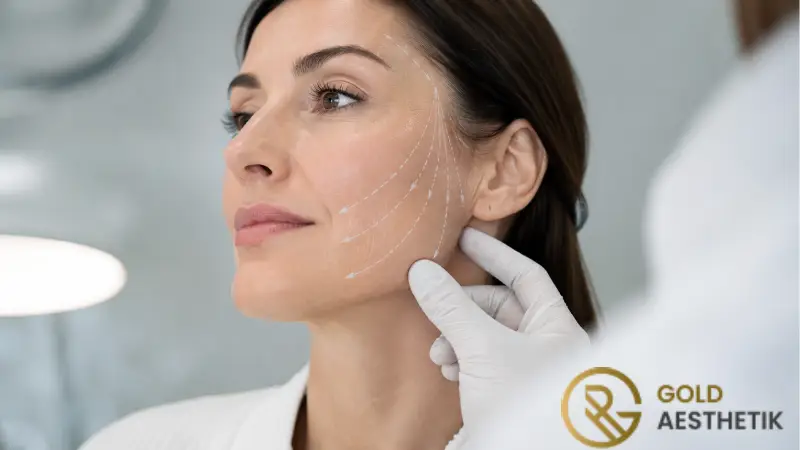
At Gold Aesthetik, the thread lift plan is created after assessing the degree of sagging, skin quality, face shape, and the desired result. The goal is a change that fits the natural facial structure – not the application of a fixed number of threads for all patients.
Dr. Mohammadreza Hagh Dadeh, a specialist in vascular surgery and aesthetic medicine, works together with the team at Gold Aesthetik in Hamburg. Before treatment, the medical history and previous aesthetic treatments should also be checked to clarify the suitability of this method.
Thread lifting is one of the treatments in the field of aesthetic medicine in Hamburg. For some people, another method may be more suitable for skin quality or sagging; therefore, the final choice should be based on individual requirements.
The Gold Aesthetik practice is located at Barmbeker Str. 40, 22303 Hamburg-Winterhude. During the consultation appointment, you can ask questions about the type of treatment, expected scope of change, recovery time, possible side effects, and aftercare appointments.

