



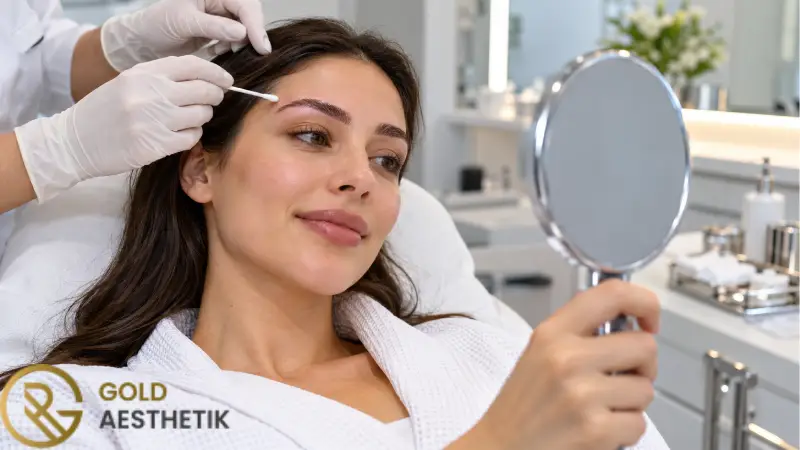
If you are wondering how an eyebrow transplantation is performed, you should know that this process is not limited to merely transferring a few hairs to the eyebrow area. To achieve a natural result, the condition of the eyebrows and the cause of thinning are first examined, then the appropriate shape is designed, and compatible follicles are selected from the donor area. In the transplantation step, the angle, direction, and placement of each graft are also of great importance.
The head, body, arch, and tail of the eyebrow do not have a uniform growth pattern. For this reason, the number of grafts alone is not a criterion for the result, and factors such as design, selection of fine follicles, hair growth direction, and the harmony of the eyebrow shape with the face must be considered together.
How is an eyebrow transplantation performed and what are the main steps?
An eyebrow transplantation usually begins with an assessment of the current condition of the eyebrows, examination of the donor area, and design of the shape. After approval of the design, suitable follicles are extracted and prepared, and then placed in the appropriate direction and angle for the different eyebrow areas.
| Step | What is done? | Main Goal |
|---|---|---|
| Consultation | Examination of eyebrows, skin, and medical history | Determining the feasibility and plan of transplantation |
| Design | Defining eyebrow head, body, arch, and tail | Harmonizing the eyebrow shape with the face |
| Donor Area Selection | Examining suitable hairs for extraction | Selecting follicles with appropriate characteristics |
| Graft Extraction | Extracting the required follicular units | Providing healthy grafts for transplantation |
| Preparation | Reviewing and sorting the grafts | Selecting suitable grafts for each eyebrow area |
| Transplantation | Placing the grafts at the designed angle and direction | Creating density and a natural shape |
| Final Assessment | Checking the shape and placement of the grafts | Evaluating the initial treatment result |
Consultation and Eyebrow Condition Assessment
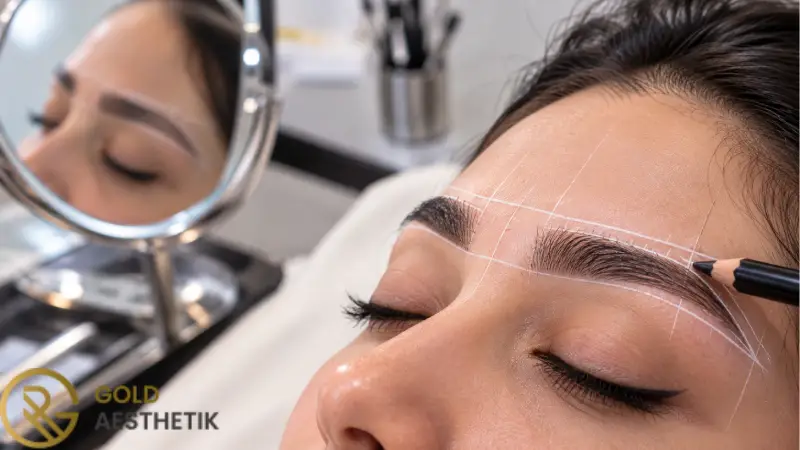
The first phase begins with assessing the extent of thinning, hairless areas, current eyebrow shape, and the quality of the donor area. In this phase, not only the appearance of the eyebrows is important; the cause of thinning must also be considered.
If the reduction in eyebrow density is new, progressive, or associated with skin problems, examining the underlying cause may be important first. The medical history, medications taken, previous injuries or surgeries, and the patient’s expectations for the outcome can also influence the treatment plan.
The consultation is a good opportunity to determine whether the patient needs a complete reconstruction of the eyebrows or if only parts such as the tail, arch, or sparse areas need correction.
Designing the eyebrow shape to suit the face
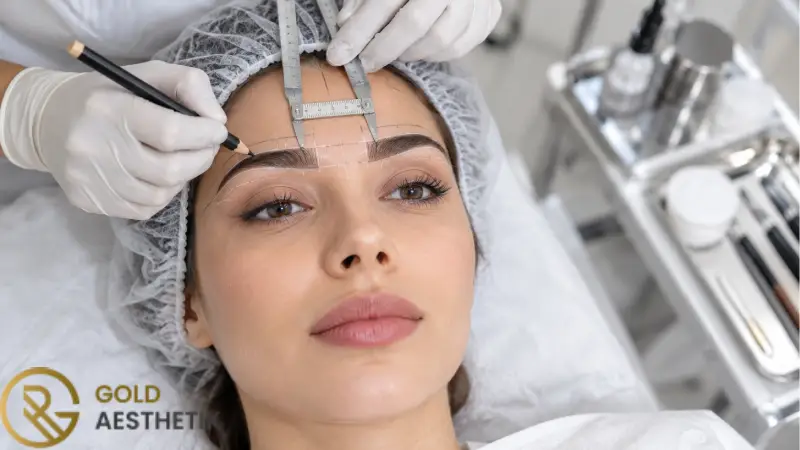
Design is one of the most sensitive steps in eyebrow transplantation. Using a fixed shape for all individuals cannot achieve a natural result. Face shape, eye shape, forehead width, distance between eyebrows, position of remaining hairs, and personal preference must be considered simultaneously.
Before transplantation, the eyebrow head, body, arch, and tail are defined. The goal is not to create two perfectly geometric and identical eyebrows; rather, the shape should harmonize with the natural asymmetry of the face and individual features.
| Factor to Review | Influence on Design |
|---|---|
| Face Shape | Determining the appropriate arch, length, and thickness of the eyebrow |
| Eye Shape and Distance | Helps determine the position of the eyebrow head and tail |
| Remaining Natural Eyebrow | Harmonizing new grafts with existing hairs |
| Expected Density | Determining the approximate number and distribution of grafts |
| Hair Characteristics | Selecting more suitable follicles for the eyebrow |
| Patient’s Expectation | Personalizing the initial design |
Selecting the appropriate area for follicle extraction
After the eyebrow shape is approved, the donor area is examined. The hairs selected for the eyebrows should match the desired design as closely as possible in terms of thickness and appearance.
The hairs extracted from the donor area do not behave exactly like natural eyebrow hairs. Therefore, selecting suitable grafts and explaining the care and styling of the new hairs after growth is important.
Extraction and preparation of hair grafts
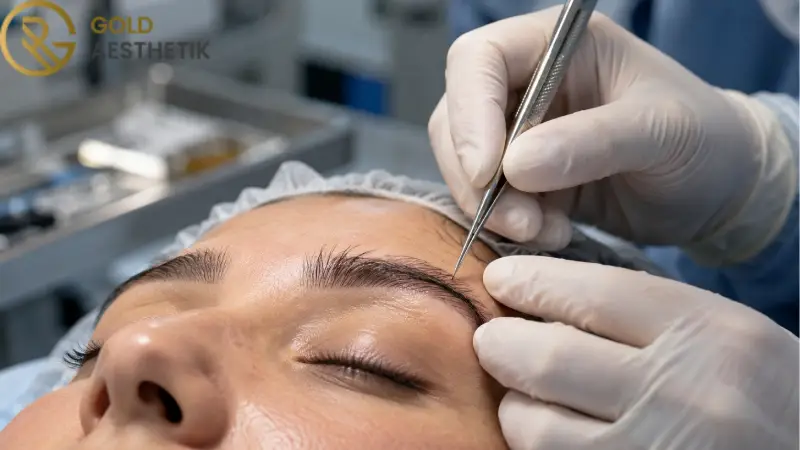
After the donor area has been determined, suitable follicles are extracted and prepared for the transplantation step. In eyebrow transplantation, not only the number of grafts is important; the type and fineness of the grafts also influence the final result.
Finer grafts are generally more important for areas such as the eyebrow edge or tail. The storage and proper preparation of the follicles until their placement in the new location is also part of the treatment process.
To better understand the concept of a graft, its difference from a single hair, and the factors that determine extraction capacity, you can also read the article Number of Grafts and Their Estimation. The required number for the eyebrows must be determined separately and based on the individual’s design.
Creating the transplantation area with appropriate angle and direction
One of the most important differences between eyebrow transplantation and hair transplantation on the scalp is the higher sensitivity of the growth angle. Eyebrow hairs usually lie close to the skin surface, and their direction changes along the eyebrow.
If all follicles are transplanted in one direction or with a similar angle, the result, even with sufficient density, can appear unnatural. The placement of each graft must be determined considering the eyebrow area.
| Eyebrow Area | General Characteristics of Transplantation | Appearance Goal |
|---|---|---|
| Eyebrow Head | Soft beginning and harmony with the natural hair direction | Avoiding an artificial starting line |
| Body | Higher density and gradual harmonization of hair direction | Creating natural volume |
| Arch | Controlled change in graft direction | Shaping the eyebrow form |
| Eyebrow Tail | Precise use of fine grafts | Creating a natural and light finish |
Transplantation of grafts and assessment of the initial result
After the recipient areas are prepared, the grafts are placed in the eyebrow area according to the original design. This step is not just about filling empty space; rather, the direction, angle, spacing, and density of each graft must harmonize with the respective area.
Finally, the shape of both eyebrows and the placement of the grafts are checked. The appearance of the eyebrows immediately after the treatment is not the final result, and sufficient time must be allowed for the stabilization of the follicles, initial hair loss, and the beginning of new growth.
How is a natural shape achieved in eyebrow transplantation?
The naturalness of an eyebrow transplantation does not depend solely on the number of hairs transplanted. Even a large number of grafts does not necessarily lead to a better result if accompanied by an unsuitable design, an incorrect angle, or an unnatural distribution.
A natural design is the result of a combination of several factors: the harmony of the shape with the face, the use of suitable grafts, the gradual change in hair direction, controlled density, and consideration of the remaining natural hairs.
Why is eyebrow shape design important before transplantation?
The initial design defines the treatment plan. In this step, the beginning of the eyebrow, the length of the body, the extent of the arch, and the position of the tail are determined.
Complete symmetry does not always mean naturalness. The human face usually shows subtle differences between the two sides, and the design should be such that the eyebrow appears harmonious in the normal face.
| Design Area | Goal |
|---|---|
| Eyebrow Start | Harmony with the eye and central facial structure |
| Arch | Creating a shape that suits the face |
| Body | Creating density and the main structure of the eyebrow |
| Eyebrow Tail | Completing the shape without stretching or unnatural thickness |
| Reviewing Both Sides | Creating balance without artificial symmetry |
Influence of face shape and eye shape on eyebrow design
One eyebrow shape is not suitable for all faces. The extent of the arch, the height of the eyebrow, and the length of the tail can vary depending on face shape, eye position, and forehead structure.
The goal is not to create a new shape detached from facial features; rather, the design should be such that the eyebrow appears as a natural part of the face after the new hairs grow.
Differences in transplantation angle for eyebrow head, body, and tail
Hair growth direction is not uniform across all parts of the eyebrow. The head, body, arch, and tail each have different patterns, and this change in direction must also be reconstructed during transplantation.
Placing all grafts at a fixed angle can create a linear and artificial appearance. Therefore, controlling the direction of each section is one of the most important technical parts of the treatment.
Importance of the growth direction of transplanted hairs
Natural eyebrow hairs usually lie on the skin surface and do not grow vertically like scalp hairs. If the created angle is too vertical, the new hairs may have a different shape than the natural eyebrow after growth.
The goal is to place the grafts as much as possible along the natural eyebrow growth pattern and to gradually design the change in direction between the head, body, and tail.
Selecting suitable grafts to avoid an artificial appearance
Not all hairs in the donor area have the same characteristics for all eyebrow areas. Using very thick grafts at the eyebrow edge or tail can make the result appear harsher.
Therefore, when selecting grafts, in addition to the number, hair thickness and the intended placement must also be considered.
| Influencing Factor | Desirable Result | Possible Error |
|---|---|---|
| Fine Grafts | Softer and more natural appearance | Disproportionate use of thick hairs |
| Appropriate Angle | Natural hair growth on the skin | Excessive vertical growth |
| Individual Design | Harmony with the face | Using a fixed model for everyone |
| Appropriate Density Distribution | Balanced shape | Overly dense transplantation |
| Gradual Transition | Natural beginning of the eyebrow | Creating a straight and defined line |
Is an appropriate density better or an overly dense transplantation?
A higher number of grafts does not necessarily mean a better result. The density should be determined based on the available space, natural eyebrow hairs, the thickness of the grafts, and the designed shape.
The main goal is to create a balance between shape, density, angle, and growth direction. An exclusive focus on increasing the number of grafts can compromise the quality of the natural design.
What happens after an eyebrow transplantation and when is the result visible?
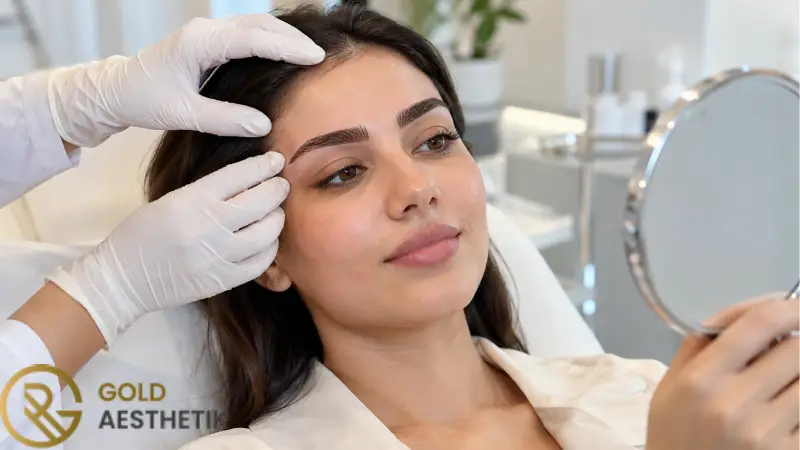
The final result of an eyebrow transplantation is not immediately assessable. In the first few days, the eyebrows may look different from the future result due to the freshly transplanted hairs, the entry points of the grafts, and possible swelling.
The transplanted follicles must undergo a phase of stabilization, healing, and a new growth cycle. The timing of these phases is not exactly the same for all individuals, and skin condition, graft quality, and individual response can influence the growth process.
Condition of the eyebrows in the first few days after transplantation
In the first few days, the grafts are in the initial stabilization phase. Redness, slight swelling, or small scabs may be observed in the transplantation area.
During this time, the specific instructions of the doctor regarding washing, contact with the area, sleeping, and eyebrow care should be followed. Manipulation or scratching of the area in the first few days can stress the fresh grafts.
| Period | Possible Condition | Important Note |
|---|---|---|
| First Day | Grafts have just been placed in the new location | Avoid pressure and unnecessary contact |
| First Days | Slight redness or swelling may occur | Perform care according to medical recommendation |
| First Week | Small scab formation is possible | Scabs should not be removed independently |
| Later Weeks | Some of the original hairs may fall out | Hair loss does not necessarily mean follicle loss |
| Later Months | New growth gradually appears | The result should be evaluated over time |
Redness, swelling, and scabs after transplantation
Redness, slight swelling, and small scabs may occur in the initial phase. The intensity and duration of these symptoms vary from person to person.
If severe pain, unusual discharge, increasing redness, or concerning symptoms occur, the condition should be examined by a doctor, and one should not rely solely on general internet advice.
Is the initial hair loss of transplanted hairs normal?
The shedding of some of the transplanted hair shafts in the following weeks can occur and does not necessarily mean the loss of the follicle. The follicle can remain in the skin and enter a new growth phase after a resting period.
For this reason, the appearance of the eyebrows in the first few weeks should not be used as a basis for evaluating the final result.
| Observed Change | Can occur in the normal course? | When is an assessment important? |
|---|---|---|
| Initial Hair Loss | Yes | In case of unusual symptoms |
| Slight Redness | Can occur | If severe or increasing |
| Small Scabs | Can occur | If associated with inflammation or unusual discharge |
| Slight Swelling | Can occur | If severe or persistent |
| Severe Pain | Should not be ignored | Requires medical examination |
When does eyebrow regrowth begin?
New growth usually does not begin immediately after the initial hair loss. The follicles can remain in the resting phase for a period, and then hair growth gradually begins.
The timing of growth onset and the speed of density increase are not the same for all individuals. Therefore, a fixed and final date for the result of an eyebrow transplantation should not be set for all patients.
The process of density increase in the following months
Not all follicles become active at the same time. It may be that initially only some of the new hairs become visible, and in the following months, the number of growing hairs increases.
Hairs taken from the scalp for the eyebrows may retain the growth characteristics of the donor area to some extent after growth; therefore, regular trimming and shaping may be part of long-term care.
| Approximate Period | General Condition |
|---|---|
| First Weeks | Skin healing and possible initial hair loss |
| First Months | Resting phase of some follicles |
| Later Months | Gradual onset of new growth |
| Continued Growth Phase | Increasing density and clearer eyebrow shape |
| Later Follow-up | Possibility of a more precise assessment of the final result |
If you want to better understand the entire cycle of stabilization, initial hair loss, and growth of transplanted follicles, the article Hair Growth Phases After Transplantation provides additional information about the behavior of transplanted follicles. The exact timeline for eyebrows must be assessed separately and according to individual conditions.
When can the result of an eyebrow transplantation be assessed?
To assess the result, sufficient time must be given for the follicles to grow. The growth rate varies from person to person, and the final density should not be assessed in the first few months.
In the follow-up examinations, the growth process, eyebrow shape, density, and growth direction of the new hairs can be checked, and individual care recommendations can be given if necessary.
Eyebrow Transplantation with Natural Design at Gold Aesthetik Hamburg
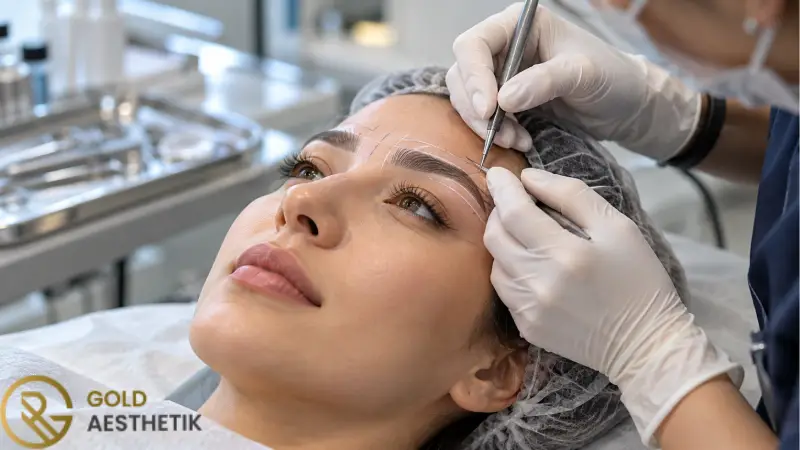
In eyebrow transplantation, natural design, the selection of suitable grafts, and the control of angle and growth direction are just as important as follicle transfer. Therefore, the treatment plan should be based on the current eyebrows, facial features, donor area, and the patient’s expectations.
At Gold Aesthetik Hamburg, each patient’s conditions are reviewed before treatment to determine if an eyebrow transplantation is suitable for them and which shape and density best suit their facial features.
If you are still in the research phase, the comprehensive guide to eyebrow transplantation in Hamburg provides information on suitable candidates, steps, costs, care, and choosing a center all in one place.
Further options for hair transplantation and hair treatments can be found on the page Hair Services at Gold Aesthetik.
Clinic Address: Barmbeker Str. 40, 22303 Hamburg-Winterhude

