



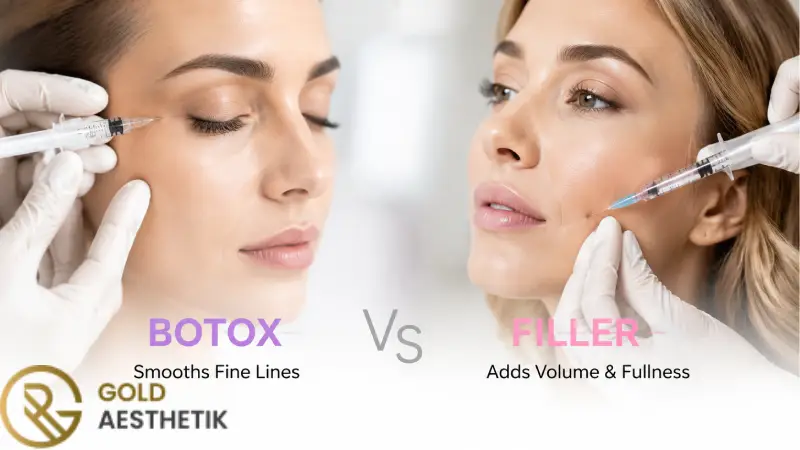
Choosing between Botox and filler depends not only on age, the number of wrinkles, or personal preferences. What matters is whether the change in the face is primarily caused by muscle activity or by volume loss, hollows, and structural changes in the tissue. Botox and fillers are both injectable treatments in aesthetic medicine, but they work differently—neither is a clear substitute for the other.
In short: Botox is mainly used to temporarily reduce the activity of certain muscles and smooth dynamic lines such as glabellar lines, forehead lines, and crow’s feet. Fillers are more likely to be used to restore lost volume, correct hollows, and shape areas such as the cheeks, lips, chin, and jawline in a controlled way. In some people, both factors are present at the same time, so after an examination the physician may also consider a combined treatment.
Differences between Botox and filler in terms of effect, application, and results
The key difference between Botox and filler is what they do after injection. Botox reduces the activity of the target muscle for a certain period of time, while a filler adds volume or structural support to the tissue. This difference determines which method is better suited to a specific concern.
| Comparison criterion | Botox | Filler |
|---|---|---|
| Primary effect | Temporary reduction of target muscle activity | Volume restoration or tissue support |
| More suitable for | Lines caused by muscle movement | Volume loss, hollows, and shape correction |
| Common areas | Forehead, glabellar area, and eye area | Lips, cheeks, chin, jawline, and certain hollows |
| Type of result | Reduced contraction and smoothing of dynamic lines | Correction of volume, shape, or facial contour |
| Onset of visible change | Gradual | An initial change is usually visible immediately |
| Are they interchangeable? | No | No |
How does Botox affect the facial muscles?
In everyday use, the term “Botox” is often used for injections of products that contain botulinum toxin type A. This active ingredient temporarily reduces signal transmission from the nerve to the target muscle—thereby decreasing the strength of muscle contraction.
As a result, lines that form when frowning, raising the eyebrows, or laughing appear softer. The forehead, the area between the eyebrows, and crow’s feet at the outer corner of the eye are among the best-known areas for an aesthetic Botox treatment.
The goal of a properly performed treatment is not to completely “freeze” the face. Before injection, dosage, muscle strength, eyebrow position, facial symmetry, and the interaction of different muscles should be assessed. Overdosing or poorly chosen injection points can lead to a heavy feeling, asymmetries, or an unwanted change in natural facial expression.
How does a filler correct volume loss and hollows in the face?

Dermal fillers are substances injected into a specific tissue layer or depth to restore lost volume, provide more support to the tissue, or change the shape of an area in a controlled way. Many fillers used in aesthetic medicine are based on hyaluronic acid.
Not all fillers have the same properties. The product’s consistency, elasticity, and structural characteristics must match the injection area and the treatment goal. A product suitable for subtle lip shaping is not necessarily the right choice to build structural support in the chin or along the jawline.
A filler may be considered for cheek volume loss, lip shaping, chin correction, the jawline, and certain hollows. However, more volume does not automatically mean a better result. Product selection, injection depth, and matching the added volume to the bony structure and soft tissue are crucial for a natural outcome.
Difference between dynamic and static wrinkles
A dynamic wrinkle becomes more pronounced when a muscle is active—for example when frowning, laughing, or raising the eyebrows. A static wrinkle is visible even when the face is at rest. However, the boundary between the two is not always clear-cut.
A dynamic line that forms repeatedly over years can gradually remain visible even at rest. Conversely, some static lines are more likely to result from volume loss, changes in skin quality, or reduced support of deeper tissue layers.
For this reason, the decision between Botox and filler is not made solely based on the location of a line or its apparent depth. The physician must assess the predominant cause.
| Type of concern | Typical sign | Possible method |
|---|---|---|
| Dynamic wrinkle | Becomes visible when frowning, laughing, or raising the eyebrows | Often Botox |
| Static line due to repeated movement | Visible even at rest | Botox and, if necessary, an additional method |
| Volume loss | Hollowing or reduced tissue support | Often filler |
| Combination of movement and volume loss | Static line with clearly active musculature | Consider a combination treatment |
Does Botox look more natural—or filler?
Neither method is inherently more “natural” than the other. A natural result is achieved when the method is chosen to match the main cause and the treatment amount fits the actual facial structure.
If a line is caused mainly by strong muscle contraction, adding volume with filler may not necessarily address the cause. Conversely, Botox cannot restore lost volume in a hollow or in cases of cheek volume loss.
A good result should not only improve the desired area, but also preserve natural facial expressions, relative symmetry, and the overall identity of the face. This is why a conservative, step-by-step approach is important for many injectable treatments.
When is the simultaneous use of Botox and filler considered?

A combination treatment may be considered when both active dynamic lines and volume loss or structural tissue changes are present. For example, lines around the eyes may be primarily muscle-related, while the same person also has cheek volume loss.
In such cases, Botox and filler do not serve the same purpose; each targets different aspects of facial change. Whether treatment is performed at the same time or in stages should be determined based on the individual situation, the treatment area, and the physician’s plan.
Which is better for which facial area: Botox or filler?
You cannot decide whether Botox or filler is better based on the name of an area alone. Even in the same facial area, the cause can be completely different in two people. The physician should assess muscle movement, tissue volume, bony shape, skin quality, and age-related changes together.
| Facial area | More common choice | Primary goal |
|---|---|---|
| Forehead and glabellar lines | Botox | Reduction of dynamic lines |
| Eye area | Botox | Reduction of lines caused by laughing and squinting |
| Tear trough (under the eye) | Filler only for selected individuals | Correction of a hollow due to volume loss |
| Nasolabial fold | Filler or combination plan depending on the cause | Improving tissue support and fold depth |
| Lips, cheeks, and chin | Filler | Volume and shape correction |
| Jaw angle | Botox or filler depending on the cause | Reducing muscle bulk or enhancing contour |
Is Botox better for forehead lines—or filler?
Horizontal forehead lines usually become more pronounced when the eyebrows are raised and are related to the activity of the frontalis muscle. Therefore, Botox is often the main method considered for these lines.
The amount and injection points must match muscle strength, forehead height, eyebrow position, and the activity of other muscles. The goal is not to eliminate forehead movement completely, but to control it in a way that preserves natural facial expression.
Fillers are generally not the first choice for dynamic forehead lines. In addition, filler injections in areas with sensitive vessels require special medical assessment and expertise.
For a more detailed look at this area, you can read the guide Botox for the Forehead and Glabellar Lines.
Is Botox suitable for glabellar lines—or filler?

Glabellar lines between the eyebrows are usually strongly related to repeated contractions of the muscles in this area. By temporarily reducing muscle activity, Botox can make the lines caused by frowning appear softer.
If the line has been present for a long time and is also visible at rest, reducing muscle activity can improve its appearance but may not necessarily eliminate it completely. Skin quality and the depth of the change should also be assessed.
A filler in this area is not considered a general, straightforward standard choice. Sensitive vessels between the eyebrows mean that any decision for a filler injection must be medically assessed very carefully.
Is Botox better for wrinkles around the eyes—or filler?
Crow’s feet at the outer corner of the eye usually become more pronounced when laughing or squinting and have a muscular origin. In this case, Botox is generally considered more often than filler.
However, if the main issue under the eye is a hollow, skin laxity, swelling, or reduced skin quality, the situation is different. Botox cannot replace lost volume, and fillers are not the right choice for every concern around the eyes.
For the tear trough: Botox or filler?
In selected individuals, a filler can make the hollow under the eye—caused by anatomy or volume loss—less visible. However, the lower eyelid region is one of the areas where careful patient selection is particularly important.
Pronounced swelling, significant skin laxity, a tendency to fluid retention, or certain structural features can limit the filler result or make the area look heavier. Botox also does not create volume and is not intended to fill the tear trough.
Treatment of this area should be performed after a thorough assessment of the skin and tissue around the eye; the presence of a hollow alone is not sufficient to assess filler suitability.
Is Botox better for the nasolabial fold—or filler?
The nasolabial fold is usually not a concern with only one cause. Cheek volume loss, altered midface support, skin quality, and natural mouth movement can all contribute to it appearing deeper.
For this reason, filler is assessed more often than Botox in this area—however, it is not always necessary to inject large amounts of filler directly into the fold. Sometimes a controlled correction of cheek volume or the surrounding structure leads to a more balanced result.
Botox is generally not the first choice for the nasolabial fold, as the muscles around the mouth play an important role in smiling, speaking, and natural lip movement.
The guide Filler for Nasolabial Folds and Cheeks explains in more detail the difference between directly correcting the nasolabial fold and restoring support in the cheek area.
Which is better for lips, cheeks, and chin: Botox or filler?
If the goal is controlled lip volume enhancement, cheek definition, or chin shape correction, a filler is usually the more suitable method. The product type and injection amount should match the facial structure and the needs of the respective area.
Botox does not create true volume. While it can be used in some treatment plans to make limited changes to muscle activity around the lips or chin, this use differs from volume enhancement with filler.
Is Botox better for the jaw angle—or filler?
The jaw angle is one of the best examples of how important it is to clarify the cause. If the lower face appears wider due to a large and active masseter muscle, masseter Botox may be an option after medical assessment.
If the main issue is a lack of structural support, a poorly defined jawline, or the chin shape, a filler may be considered to improve contour. In some people, both factors are present at the same time, so a combined treatment plan may be more appropriate.
For a comprehensive classification of this difference, you can read the article Jaw Angle Definition with Filler.
| Situation in the area | Botox | Filler | Combination treatment |
|---|---|---|---|
| Forehead and glabellar lines | More common choice | Usually not the first choice | Only in selected situations |
| Lines in the eye area | Can be considered for dynamic lines | Not the primary use for the dynamic lines themselves | If there is also, for example, volume loss |
| Tear trough | Does not fill the hollow | Can be considered for selected individuals | Depends on additional concerns in the area |
| Nasolabial fold | Usually not the primary choice | Can be considered depending on the cause | For multifactorial concerns |
| Lips, cheeks, and chin | Does not create volume | More common choice for volume and shape correction | With a separate indication |
| Wide jaw due to musculature | Can be considered | Does not reduce the muscle | If there is simultaneous structural weakness |
Does Botox last longer—or filler?
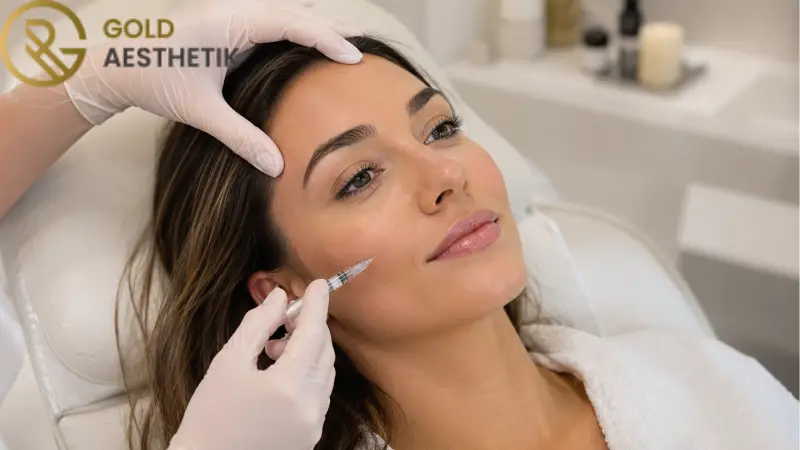
The duration of results differs between Botox and filler, but longer longevity should not be the main criterion when choosing a treatment. The treatment area, product type, injection amount, muscle strength, metabolism, and individual factors can influence duration.
The effect of Botox usually lasts for a few months, after which muscle activity gradually returns. Hyaluronic acid fillers can last for different lengths of time depending on the product and injection area. Highly mobile areas often behave differently from structural areas such as the chin or cheeks.
| Time criterion | Botox | Filler |
|---|---|---|
| Onset of effect | Usually within a few days | An initial change is often visible immediately |
| More accurate assessment of the result | Usually after the time needed for full effect | After swelling and the initial tissue reaction subside |
| Type of longevity | Temporary | Depending on filler and area, usually temporary |
| Wearing off | Muscle activity gradually returns | The filler is gradually broken down |
| Timing of repeat treatment | Depending on the return of movement and medical assessment | Depending on filler status and actual need |
When are the results of Botox and filler visible?
The Botox result is not visible immediately after injection. The reduction in muscle activity develops gradually, so assessing it in the first few days may be premature.
With fillers, the volume change is usually visible immediately, but swelling and the initial tissue reaction can temporarily make the area look larger or asymmetrical. The more accurate result is best assessed after these changes have subsided.
How do the side effects of Botox and filler differ?
Redness, sensitivity, mild pain, and bruising at the injection site can occur after both treatments. The type and extent of side effects depend on the injected material, the treatment area, the injection technique, and individual factors.
With Botox, an unwanted change in muscle activity can lead to asymmetries, a heavy feeling, or temporary drooping of certain areas. With fillers, in addition to swelling and bruising, there are also risks such as nodule formation, asymmetries, inflammation, and vascular complications.
| Method | More common reactions | More important complications | When to contact the physician |
|---|---|---|---|
| Botox | Redness, sensitivity, bruising, or headache | Unwanted muscle weakness and pronounced drooping | For severe, unexpected, or worsening symptoms |
| Filler | Swelling, sensitivity, bruising, and initial asymmetry | Infection or impaired blood supply to the tissue | For severe pain, skin discoloration, or other warning signs |
What warning signs are there after a filler injection?
Severe or increasing pain, unusual blanching or darkening of the skin, a cold sensation in the area, net-like skin discoloration, blistering, visual disturbances, or neurological symptoms should be taken seriously.
If filler unintentionally enters a blood vessel, it can impair blood flow to the tissue and requires prompt medical assessment. If unusual symptoms occur, the injection site should not be massaged independently, and you should not wait for the symptoms to resolve on their own.
Can the result of Botox or filler be corrected?
The effect of Botox cannot be fully neutralized immediately. If an unwanted change occurs, the physician will decide—depending on the issue—whether to wait for the gradual wearing off or whether another measure is required.
Some hyaluronic acid fillers can be dissolved with hyaluronidase under certain conditions. However, not all fillers are the same, and the decision to dissolve or correct should be made by the physician after assessing the product type, injection area, and cause.
Is Botox more expensive—or filler?
A direct cost comparison between Botox and filler without defining the area and treatment goal is not precise. Botox costs can vary depending on the number of areas, the extent of muscle activity, and the amount required. With fillers, product type, filler amount, treatment area, and the complexity of planning influence the cost.
| Cost factor | Impact for Botox | Impact for filler |
|---|---|---|
| Treatment area | Number of areas and muscle strength are important | Type and complexity of the area are important |
| Amount of material | The required amount is determined depending on the muscle and treatment plan | The required volume is determined depending on shape and treatment goal |
| Product used | The product used may vary | Type and properties of the filler influence selection |
| Complexity of treatment | Planning injection points and muscle balance is important | Planning volume, depth, and contour is important |
| Follow-up appointment | Assessment of results and symmetry | Assessment of swelling, symmetry, and final shape |
Cost should not be the only criterion for an injectable treatment. The physician’s qualifications, product quality, hygiene standards, anatomical expertise, and the availability of aftercare in the event of complications are also important.
For further details, you can—depending on the treatment you want—read the guides Costs for Botox in Hamburg and Germany and Costs for Filler in Hamburg.
Pre- and aftercare for Botox and filler
Before both treatments, you should inform the physician about your medical history, known allergies, prescription medications, dietary supplements, and previous aesthetic treatments. Inflammation, infections, or active issues in the injection area must also be clarified before treatment.
No prescription medication—especially those that affect blood clotting—should be discontinued solely to reduce the risk of bruising and without consulting a physician.
Aftercare after Botox
After Botox, avoid massaging on your own or applying pressure to the injection sites; follow your physician’s individual recommendations. The timing for returning to exercise or other activities should also follow the instructions given during the treatment session.
Aftercare after filler
After fillers, it is also advisable to avoid pressure, self-massage, and manipulation of the area. Strong heat, intense exercise, or direct pressure may—depending on the treatment area and medical recommendation—be restricted for a certain period of time.
Because tissue response and treatment plans vary individually, your physician’s personal aftercare instructions take precedence over general recommendations.
Botox or filler—which is more suitable for you?
If your main concern is lines that form when frowning, laughing, or raising the eyebrows, Botox usually matches the cause better. If the main issue is volume loss, hollows, or shape correction, a filler is more likely to be considered.
However, many facial changes are multifactorial. A person may have both dynamic lines and have lost some cheek volume or tissue support. In such cases, it is not sufficient to choose a method based only on age or the appearance of a line.
The physician should assess muscle movement, bony shape, skin quality, the extent of volume loss, previous treatments, and the person’s expectations together. Sometimes the best decision is a single treatment—sometimes a staged or combined approach is more appropriate.
Who needs a more detailed assessment before Botox or filler?
People with relevant underlying conditions, known allergies, active infections or inflammation in the treatment area, or who are taking certain medications should discuss their situation with the physician before injection. Previous complications after an earlier injection should also be disclosed.
Pregnancy, breastfeeding, or certain medical situations can affect the decision for a treatment or its scheduling and require an individual assessment.
Frequently asked questions about Botox or filler
Which is better for facial rejuvenation: Botox or filler?
That depends on the type of facial changes. Botox primarily targets lines caused by muscle activity, while fillers are used for volume loss and shape correction. In some people, both factors are present.
Does a filler eliminate forehead lines?
If forehead lines are mainly caused by muscle movement, Botox is usually the more suitable method. A filler injection in the forehead is not considered a general treatment for dynamic lines and, due to the anatomical characteristics of the area, should be assessed with particular caution.
Does Botox add volume to the face?
No. Botox is not a volume-building material and does not replace lost volume. Its primary effect is the temporary reduction of target muscle activity.
Does a filler reduce the jaw muscle?
No. A filler adds volume to the tissue and is not used to reduce the masseter muscle. If jaw width is due to an enlarged muscle, the physician may consider masseter Botox.
Can Botox and filler be combined in one treatment plan?
In some people, yes. If different concerns such as dynamic lines and volume loss are present at the same time, the physician may include both methods in a staged or combined treatment plan.
From what age do Botox or fillers make sense?
Age alone is not a suitable criterion for choosing a treatment. More important are a genuine indication, the skin and tissue situation, the extent of muscle activity, volume changes, and the individual goal.
Botox and filler consultation at Gold Aesthetik Hamburg
At Gold Aesthetik Hamburg, the decision between Botox and filler is made based on an examination and an individual assessment. Facial expressions, skin quality, tissue volume, bony shape, and facial proportions are evaluated before a therapy recommendation is made.
The goal is to ensure that the chosen method matches the main cause of facial changes and that unnecessary treatments or overcorrections are avoided. Treatment results and longevity can also vary from person to person; an identical result for everyone cannot be guaranteed.
Gold Aesthetik is located at Barmbeker Str. 40, 22303 Hamburg-Winterhude. During the consultation, you can discuss with the physician the differences between Botox and filler, expected results, limitations, risks, and the most suitable option for your situation.

